The best AI voice agent platforms in 2026
This ranking compares ten AI voice agent platforms on price per minute, telephony, provider choice and EU hosting. Micdrop publishes it and sits fourth.
September 13, 2026
Godefroy de CompreignacUpdated on November 4, 2026
Key takeaways
- Most hosted voice agent platforms bill by the minute. Vapi charges a $0.05 platform fee on top of your providers, Telnyx $0.05 with speech included, Twilio ConversationRelay $0.07, Retell AI $0.07 to $0.31 and Bland $0.14 with every model included, while Synthflow sells only annual enterprise contracts with no published price.
- With open source voice agent software, you pay for the servers you run instead of a per-minute platform fee. LiveKit and Pipecat also sell managed clouds from $0.01 an agent minute. Dograh packages a whole phone platform as a Docker stack you host yourself.
- Bland, Synthflow and Telnyx offer European hosting, as do the managed clouds of LiveKit and Pipecat. Twilio runs its default speech-to-text in the US only, Retell AI operates no services in the EU, and Vapi keeps its EU region for its top Premier package, sold through its sales team.
- Micdrop sits fourth in a ranking it publishes. It is a TypeScript library written by one maintainer, with no phone numbers, dashboard or managed hosting. Products such as Cibli and Raconte run it in production, though the same maintainer builds Raconte.
- Speech and model vendors now sell agent products of their own, such as ElevenAgents from ElevenLabs and the OpenAI Realtime API. Each one ties the voice, or the whole model, to that vendor.
Conversational AI voice agents let a person talk out loud with a language model: they listen, transcribe, ask the model, speak the answer and handle interruptions. In 2026 you can build one in three ways. A hosted platform such as Vapi, Retell AI or Bland runs everything for a price per minute. An open source framework such as LiveKit, Pipecat or Dograh gives you the same loop as code on your servers, with a managed cloud on top if you want one. A library such as Micdrop runs the conversation inside the app you already ship. This ranking of AI voice agent platforms covers all three and puts the open source options first, with LiveKit at the top.
Micdrop publishes this ranking and sits fourth in it, so keep that in mind as you read. Each ranked platform links to its own site. Every price comes from the vendor’s pricing page unless it is marked as a third-party estimate. Micdrop’s limits appear in its entry, in the takeaways and in the FAQ.
Ten platforms are ranked in two groups: four open source options that run on infrastructure you control, then six hosted services you rent. The figures were collected on 13 September 2026 and checked again on 4 November 2026. Prices in this market change every quarter, so check them again before you sign.
How the platforms were ranked
Each platform was compared on six points:
- what you have to operate, which can be nothing at all, a media server or a Docker stack
- telephony, meaning phone numbers, SIP trunks and contact centre integrations
- provider choice, meaning whether speech-to-text, the model and text-to-speech can come from vendors you pick, on your own keys
- the price, as published on the vendor’s own pricing page, with third-party figures marked as such
- where the data can stay, including a European region
- public evidence, meaning named customers, GitHub stars and compliance certifications stated on a first-party page
Each entry covers the points where that platform stands out. The order is a judgement call, with no weighted score of those six points behind it. The open source group comes first, because a team building voice into its own product keeps the code, the providers and the data location, and can still buy a managed cloud later. That choice favours the publisher of this ranking, whose product is open source. Inside the group, the platforms that suit more kinds of voice agent project rank higher. LiveKit and Pipecat fit almost any project, Dograh fits teams that want a complete phone agent platform on their own machines, and Micdrop fits the narrower case of voice inside a TypeScript application.
Micdrop is a library rather than a platform. It is ranked because a team adding voice to its own app installs it in place of a platform.
The hosted group follows, ordered by how much of the stack you control on self-serve terms: first how many providers you can pick on your own keys, then how much of the agent runs in your own code. Vapi comes first, since you can use your own key for every provider. Twilio ConversationRelay, Retell AI and Telnyx each let you bring your own model, so they are ordered by where the agent runs. Twilio always leaves the agent in your code. Retell leaves it in your code only when you connect your own model. Telnyx always runs it on its own infrastructure. Bland runs only its own models, so it follows Telnyx. Synthflow sells only annual enterprise contracts, so it comes last.
A ranking by call volume or funding would look very different. Retell AI and Bland would sit near the top, while Micdrop, a young project with 97 GitHub stars and no customer page, would come last. The entries give you the figures to build that ranking instead.
The comparison at a glance
| Platform | Type | You operate | Telephony | Provider choice | Price | EU hosting |
|---|---|---|---|---|---|---|
| LiveKit | Framework and managed cloud | Media server and worker, or nothing on Cloud | SIP | Any provider | Free, $50 or $500 a month, then $0.01/min | Region pinning on Scale |
| Pipecat Cloud | Framework and managed cloud | Python service, or nothing on Cloud | Twilio, Telnyx, Plivo, Exotel | Any provider | $0.01 to $0.03/min plus transport | Frankfurt region |
| Dograh | Self-hosted platform and cloud | Docker stack, or nothing on cloud | Seven telephony integrations | Any provider | Free self-hosted, $0.01/min cloud | Wherever you deploy |
| Micdrop | Library in your Node server | Your existing server | None | Any provider | Free, MIT | Wherever you deploy |
| Vapi | Hosted API | Nothing | Yes | Every provider, own keys | $0.05/min plus providers | Premier package only |
| Twilio ConversationRelay | Hosted speech relay | Your model server | Twilio | Your own model, speech from a list | $0.07/min plus call minutes and model | Deepgram in the US only |
| Retell AI | Hosted platform | Nothing | Seven SIP integrations | Model from a list, or your own | $0.07 to $0.31/min | None |
| Telnyx | Hosted on its own carrier | Nothing | Own carrier network | Speech from a list, any compatible model | $0.05/min plus model | Paris edge |
| Bland | Hosted, own models | Nothing | Yes | Bland models only | $0.14/min, or $0.12 on $299 a month | US, EU, APAC |
| Synthflow | Hosted enterprise platform | Nothing | Own carrier, SIP | Chosen by Synthflow | Annual contract, no public price | EU region |
Open source platforms you can run yourself
1. LiveKit
LiveKit is an open source WebRTC media server with an agent framework on top, and a managed cloud that runs both. The server, the Agents framework and the SIP gateway are Apache 2.0. Agents are written in Python or Node, and in November 2026 the Python repository alone carries 15,086 stars. The company raised a $100M Series C at a $1B valuation in January 2026, led by Index Ventures. In September 2026 it added Private Links, an encrypted tunnel from agents on its cloud to a private network, at $50 a link plus $0.10 per GB.
LiveKit has the strongest public evidence in this ranking. Its site names SAP, Oracle, Salesforce, Nvidia and Spotify as customers, and states that OpenAI uses LiveKit to deliver voice to millions of ChatGPT users. Client SDKs cover the web, iOS, Android, Flutter, React Native, Unity and embedded devices.
LiveKit Cloud starts free with 1,000 agent minutes a month and 5 concurrent sessions, then costs $50 a month for 5,000 minutes or $500 for 50,000, with extra minutes at $0.01. It carries SOC 2 Type II, promises 99.99% uptime on every plan, and pins sessions to the US, the EU or India from the Scale plan, which also unlocks HIPAA.
The JavaScript agents repository has 957 stars against the Python one’s 15,086, so most of the community writes Python. The first semantic turn-detection models ship under a LiveKit licence that restricts their use to the LiveKit Agents framework, while the newer v1-mini model is free to use anywhere.
2. Pipecat Cloud
Pipecat is the most starred open source framework built for voice agents, at 17,056 stars in November 2026, under a BSD 2-Clause licence that also covers its smart-turn model. Daily, the company behind it, made Pipecat Cloud generally available on 8 January 2026. More than 1,000 teams used the beta. The launch announcement named NVIDIA, Mercor, Descript, Epic, Vapi and Tavus as users of Daily’s products. On 29 October 2026 the speech-to-text vendor Deepgram announced it is buying Daily. Pipecat keeps its BSD licence and is set to move to an independent foundation.
The cloud bills $0.01 to $0.03 per active agent minute depending on the instance size, with unlimited concurrency. One-to-one WebRTC voice through Daily is free, SIP costs $0.003 to $0.02 a minute and PSTN $0.018. Telephony works with Twilio, Telnyx, Plivo and Exotel, plus WhatsApp. Regions include Frankfurt. Pipecat Cloud can also run as a single-tenant deployment inside your own VPC.
Pipecat itself is Python only, while the client SDKs cover JavaScript, React, React Native, iOS, Android and C++. Daily holds SOC 2 Type 2 and offers HIPAA, though at the January launch SOC 2 for Pipecat Cloud itself was still on the roadmap. The pricing page states no SLA.
3. Dograh
Dograh is a full voice agent platform published as open source. It is BSD 2-Clause, carries 6,025 stars on GitHub in November 2026, and starts on your own server as a Docker Compose stack launched by one script. Dograh presents itself as the open source alternative to Vapi and Retell. It is the only entry here that gives you a workflow builder, a dashboard and telephony on your own machines.
Telephony is broad, with Twilio, Vonage, Telnyx, Plivo, Vobiz and Cloudonix integrations plus Asterisk for teams running their own PBX. The release of 31 October 2026 added inbound WhatsApp calls. You bring your own keys for speech-to-text, the model, text-to-speech and the carrier. A web widget embeds the agent in a site in floating, inline or headless mode. Python and Node SDKs create agents and place outbound calls. Teams that would rather not host it can use the managed cloud, which charges a platform fee of one cent a minute with 10 concurrent calls. Enterprise plans add custom SLAs.
The backend is Python and builds on Pipecat, so the stack you operate includes a Python service and its storage. Dograh holds no compliance certification of its own. Its site instead lists HIPAA, GDPR, SOC 2 and ISO 27001 as frameworks that a deployment inside your own perimeter can support. No named customer appears on its site or repository.
4. Micdrop
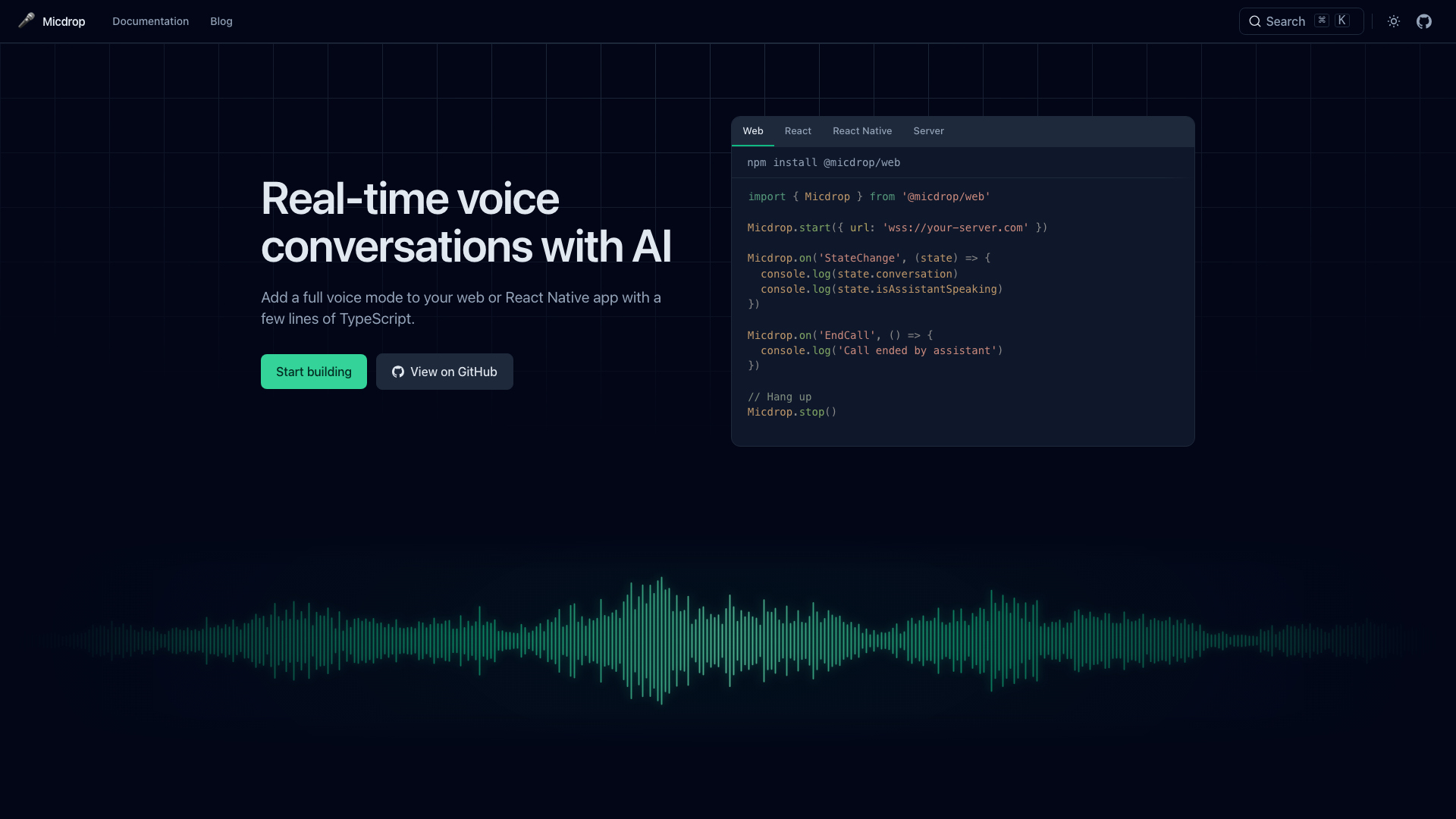
Micdrop is a set of MIT-licensed TypeScript packages that run a voice agent inside a web application and the Node server behind it. The browser package handles the microphone, voice activity detection and playback. The server package talks to the browser over a WebSocket and runs either a chain of speech-to-text, model and text-to-speech, or a single speech-to-speech model from OpenAI Realtime or Gemini Live. A React Native package brings the same client to iOS and Android. The code runs on your own servers with your own provider keys, so you pay for those servers and for what OpenAI, Google, Mistral, ElevenLabs, Cartesia, Gladia or Gradium bill you. Kokoro, Piper, Pocket TTS, Phonon, Qwen TTS and Whisper run on your own hardware instead, with no provider bill. On 21 October 2026 Micdrop added Mistral text-to-speech and Phonon, the local voice from Gradium.
Micdrop also offers provider fallback, which switches to a second vendor when the first one fails, and semantic turn detection, which asks the model whether the user has finished speaking. A fully European stack runs on Mistral, Gladia and Gradium with the same orchestration code.
The browser and server packages run in production in products such as Cibli, a recruitment platform where candidates answer out loud, and Raconte, which runs voice interviews led by an AI. Cibli comes from an independent team, while Micdrop’s maintainer also builds Raconte. Neither product publishes usage figures.
Micdrop comes without phone numbers, SIP, a dashboard, call analytics or managed hosting. One maintainer writes it, the first public release dates from 2025, the repository has 97 stars in November 2026, and the React Native package is still at 0.1. Micdrop holds no compliance certification, so compliance depends on where you host it and which providers you pick.
Hosted platforms you rent
5. Vapi
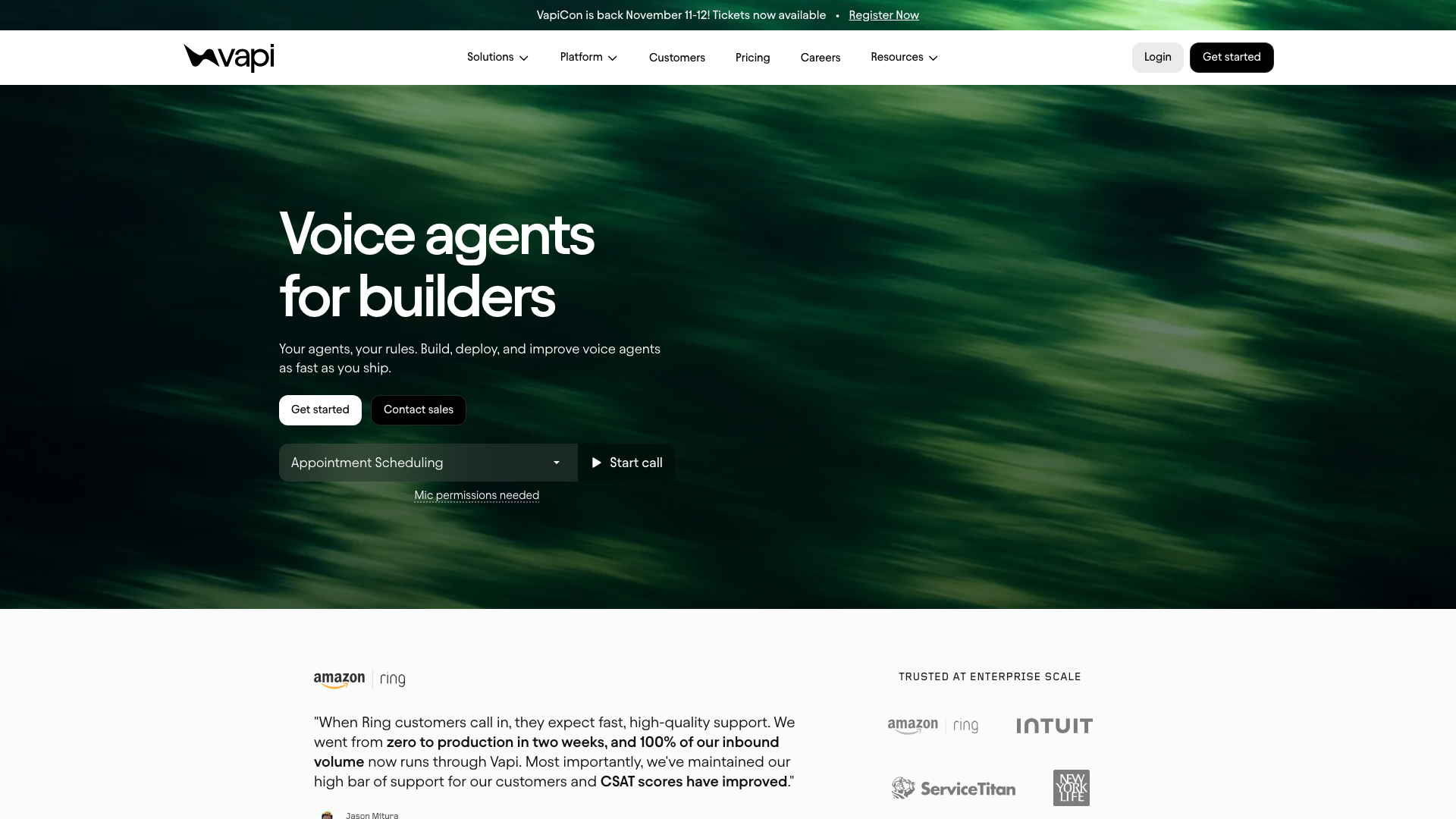
Vapi is the developer-first hosted platform, and the one that leaves the most of the stack in your hands. It charges a $0.05 platform fee per minute, then passes speech and model costs through at cost, or at zero when you supply your own keys for every provider. Since mid-September 2026, Vapi bills that fee on a usage-only plan with four concurrent lines. Paid support packages from $29 a month raise the count to 10 or 30. Each extra line costs $10 a month. Pricing guides published by CloudTalk and Telnyx put a realistic all-in cost between $0.23 and $0.33 a minute.
Vapi reports more than a billion calls and more than a million developers. It names Intuit, ServiceTitan, New York Life and Kavak as customers, along with Amazon Ring, which routes all of its inbound calls through Vapi. Vapi raised a $50M Series B in May 2026 led by Peak XV. SDKs cover the web, Flutter, React Native, iOS and Python. The trust centre lists SOC 2, GDPR and PCI DSS, with a 99.9% uptime commitment on the top Premier package.
HIPAA is a paid add-on at $2,000 a month. Zero data retention comes with the paid packages only. According to its documentation, Vapi keeps its EU region for the Premier package, sold through its sales team. Call history is kept 14 days on the usage-only plan.
6. Twilio ConversationRelay
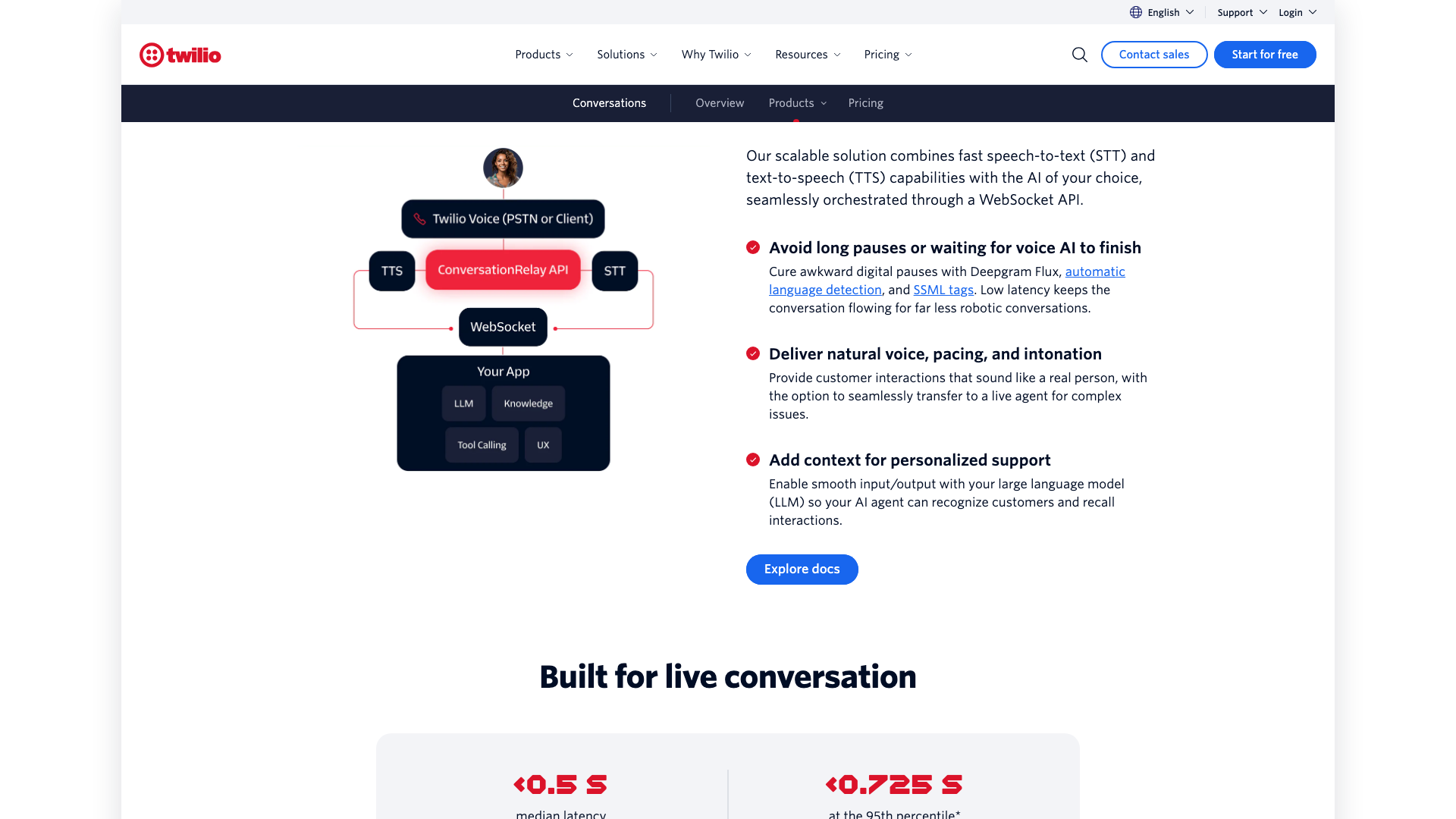
Twilio ConversationRelay splits the voice agent in two. Twilio handles the call, the speech-to-text and the text-to-speech, and sends the transcribed text over a WebSocket to a server you write, where your own model and logic answer. The prompt and the tools therefore live in your code, which can call any model you like. ConversationRelay became generally available on 14 May 2025.
The price is $0.07 a minute, on top of Twilio call minutes and your model bill. Speech-to-text runs on Deepgram by default, or on Google. Text-to-speech runs on ElevenLabs by default, or on Google or Amazon. Calls arrive from the phone network, SIP or a browser through the Twilio Voice JavaScript SDK. ConversationRelay is HIPAA eligible and supports PCI-compliant workflows, with a median latency that Twilio quotes at under half a second. Three features became generally available on 28 October 2026: changing the configuration mid-call, reconnecting to your WebSocket server, and filtering out the agent’s own echo. The company as a whole reported more than 402,000 active customer accounts at the end of 2025.
You pick speech vendors from Twilio’s short list only, with no documented option to use your own keys for them. Deepgram runs in Twilio’s US region only, which limits in-region processing for European calls.
7. Retell AI
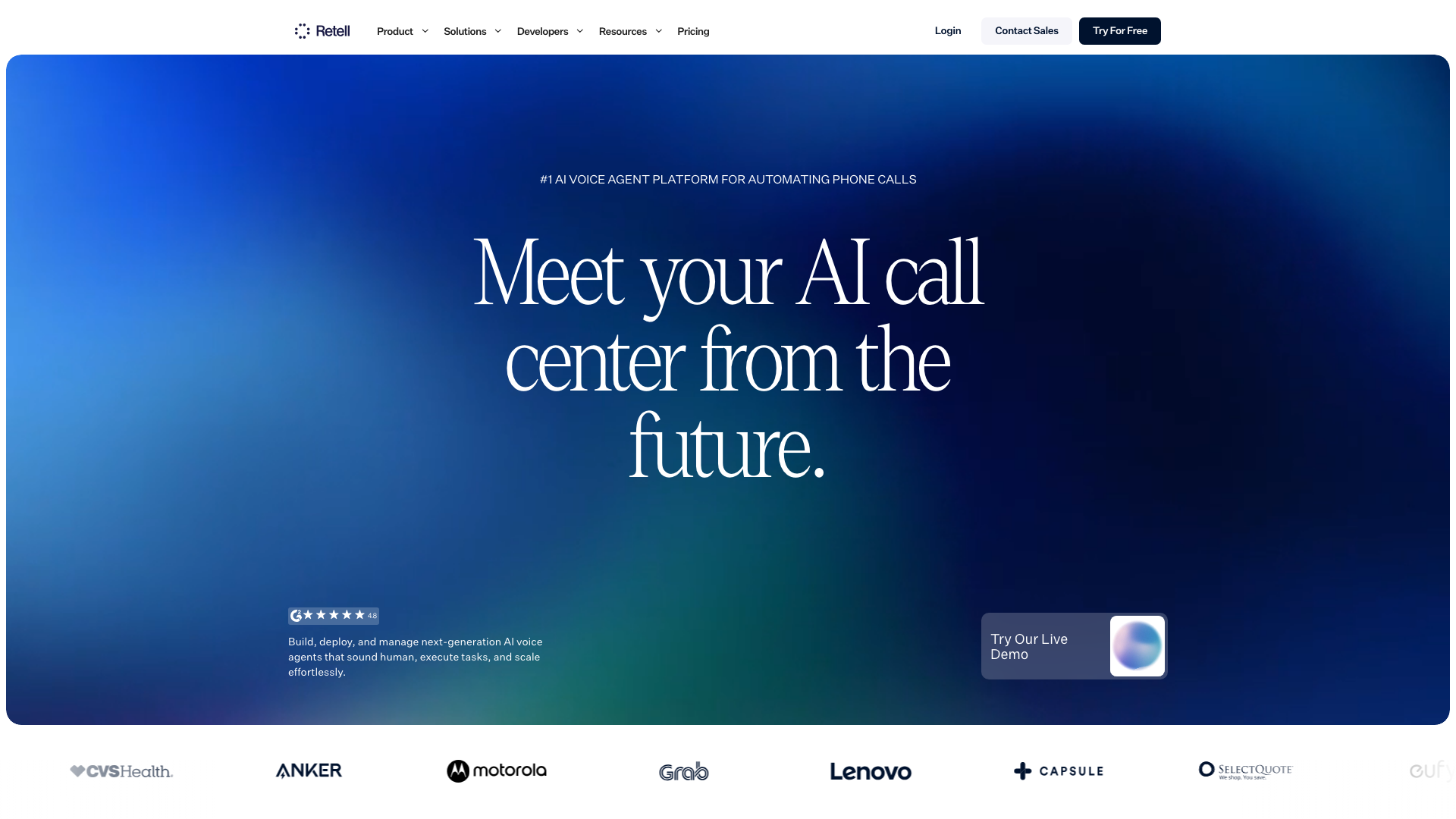
Retell AI is built for phone agents in call centres. It has the deepest contact centre integrations of the hosted group, with verified SIP guides for Twilio, Telnyx, Vonage, Avaya, Genesys Cloud, Five9 and Amazon Connect. It also includes a flow builder, an outbound dialer, PII removal and a web SDK for browser calls. You can pick a model from Retell’s list or connect your own through a WebSocket that Retell opens to your server. Since 2 November 2026 Retell also offers OpenAI’s GPT-Live-1 speech-to-speech model at $0.05 a minute, with the model billed on top.
Retell AI advertises $0.07 to $0.31 a minute and bills it in lines: $0.055 of voice infrastructure, $0.015 to $0.04 of text-to-speech on the standard voices, $0.015 of telephony, and the model, from under a cent to $0.32 a minute depending on the one you pick. With the most expensive model, those lines add up to more than the $0.31 Retell advertises. Twenty concurrent calls are included, with each extra one at $8 a month. Retell reports more than 4,000 businesses and more than 100 million calls a month, with logos including CVS Health, SelectQuote and Morgan & Morgan. The research firm Sacra estimated its annualised revenue at about $80M in August 2026, while Retell had raised a $4.6M seed round.
Its compliance documentation lists HIPAA, SOC 2 Type 1 and 2, and GDPR, and its site adds ISO 27001. The same documentation states that Retell does not currently operate services within the European Union. No SLA figure is published.
8. Telnyx Voice AI Agents
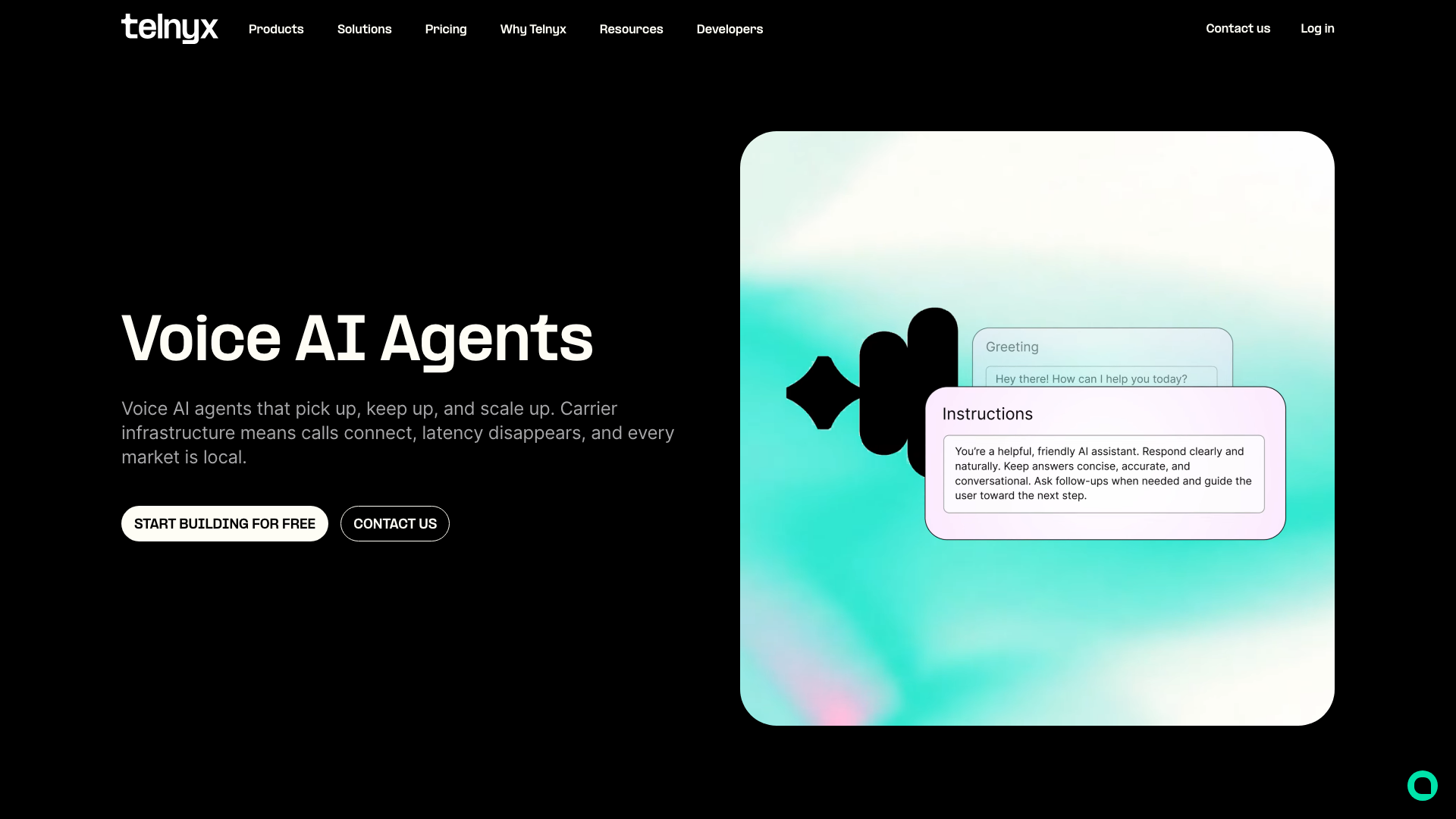
Telnyx is a licensed carrier in more than 45 countries. Its voice agents run on its own network and GPUs, so the phone line, the speech models and the orchestration come from one company under one SLA. The price is $0.05 a minute for orchestration, speech-to-text and text-to-speech together, with model tokens billed separately. Telnyx’s own worked example comes to about $0.06 a minute including inbound US telephony and the model.
You still choose the providers inside that bundle. Speech-to-text runs on Deepgram, Whisper, AssemblyAI, Speechmatics or Soniox, text-to-speech on ElevenLabs, MiniMax, Resemble, AWS or Azure, and the model on any OpenAI-compatible endpoint. Since 30 September 2026 an agent can also run on OpenAI’s GPT-Live speech-to-speech model. A Paris point of presence has run speech-to-text, orchestration and text-to-speech for European calls since July 2025. HIPAA is included on every plan, alongside SOC 2, GDPR and PCI DSS. A web widget and a React library put the same agent in a browser.
The agent logic runs on Telnyx rather than in your code. You get the lowest latency and the bundled price only while the call stays on Telnyx infrastructure. Telnyx publishes few named voice AI customers.
9. Bland
Bland runs its own speech-to-text, model and text-to-speech on its own infrastructure, so no third-party AI provider touches a call. That makes it the most vertically integrated platform here and a strong fit for regulated enterprises. It offers US, EU or APAC data residency. Enterprise customers get dedicated infrastructure plus self-hosted and on-premises deployment. Bland lists SOC 2 Type II, HIPAA and a self-attested PCI DSS, and is the only platform here with FedRAMP 20x Class A, obtained on 25 August 2026.
Pricing includes every model: $0.14 a minute with no platform fee, or $0.12 on the $299 monthly Build plan. Bland raised a $50M Series C in June 2026 led by Dell Technologies Capital, taking its funding past $100M. It reports more than 250 enterprise customers, naming Samsara, Kin Insurance, CNO Financial Group, Mutual of Omaha and TravelPerk.
Running everything on Bland means using Bland’s models and voices, with no option to bring your own keys. The entry plan caps you at 100 calls a day and 10 concurrent calls. A voice agent inside a web app can run on your own Node server, where you pick the models and pay each provider on your own keys.
10. Synthflow
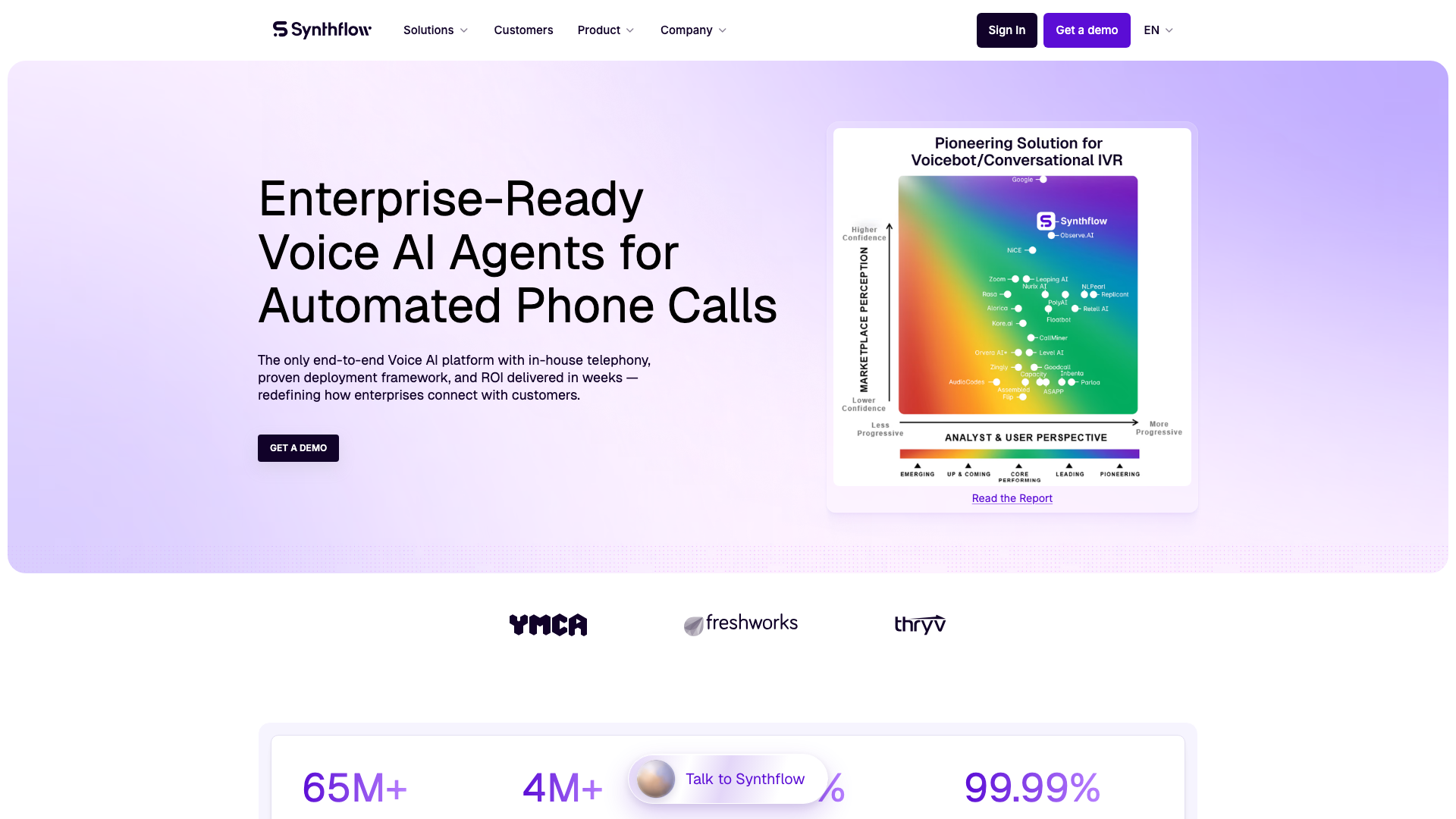
Synthflow is the Berlin-based enterprise platform, registered as AgentFlow AI GmbH, with 70 employees and $30M raised including a $20M Series A led by Accel. It runs its own telephony stack with session border controllers and media servers, accepts your own carrier over SIP, and integrates with contact centre platforms such as Genesys, Avaya and 8x8. New accounts choose a US or EU region. Since 20 October 2026 its agents also run on Zoom Phone and Zoom Contact Center.
Its trust centre lists the longest set of certifications in the group: SOC 2 Type II, HIPAA, PCI DSS, GDPR, ISO 27001 and ISO 42001. Each contract sets its own uptime commitment. Launches come with managed support. Named customers include Thryv and Freshworks. Freshworks reports automating 65% of its routine calls on Synthflow.
Synthflow sells annual enterprise agreements scoped to each customer and publishes no price. The older pay-as-you-go option is gone. Browser calls stream audio over a WebSocket that your backend opens, with no packaged SDK. Synthflow states more than a million calls a day across more than 30 countries. Teams adding voice to a TypeScript web app without an annual contract can compare it with an open source Synthflow alternative.
Not ranked, and why
Speech and model vendors now sell voice agent products of their own. ElevenAgents from ElevenLabs costs $0.08 a minute plus the model, the Deepgram Voice Agent API $0.075 a minute at its standard rate, Cartesia’s Managed Agents $0.03 a minute at their launch rate, and xAI’s Grok voice API $0.08 a minute. The OpenAI Realtime API and the Gemini Live API bill their speech-to-speech models per token. OpenAI’s GPT-Live-1 is the exception, billed at $0.05 a minute since September 2026. Each of them locks you into its own speech stack or its own model. Several are also providers that the ranked platforms plug in, which is why they appear here without a rank. You can also compare one realtime model against an assembled pipeline.
Enterprise customer experience suites are left out too. PolyAI, Sierra and Parloa sell voice alongside chat through sales-led contracts with no public platform price, to buyers such as Marriott, Hyatt and Allianz. They suit a company buying a finished service through procurement, while this ranking covers the tools a team builds its own agent with.
Three names from older rankings have left this market. Layercode pivoted to another product in February 2026, Lindy now sells a personal assistant rather than a phone agent builder, and the voice product sold as Air AI is defunct after a settlement with the US Federal Trade Commission in March 2026.
Choosing how to build conversational AI voice agents
Start with what the voice agent is for, since that decides whether you need a hosted platform, an open source framework or a library in your own app.
If the product is phone calls, the hosted group is the shorter path. Vapi suits a developer team that wants to keep its own provider contracts and pay a visible platform fee. A team that needs to plug into Genesys, Five9 or Amazon Connect this quarter should look at Retell AI. Bland suits a regulated enterprise that wants on-premises deployment and FedRAMP, as long as it accepts Bland’s own models. A buyer ready to sign an annual enterprise contract gets EU hosting, a long list of certifications and managed launch support from Synthflow. Test Telnyx when you want the carrier and the models from a single company, with European calls processed in Paris. Twilio ConversationRelay fits a team already on Twilio that wants the model and the prompt in its own code.
If you want a phone agent platform without renting one, Dograh gives you the builder, the dashboard and the telephony integrations as a Docker stack you run yourself, for the price of operating a Python service.
If voice is a feature inside your own application, the open source group fits better. LiveKit and Pipecat cover almost any project, phone, video and mobile included. Both also sell a managed cloud for teams that would rather not run the servers themselves. LiveKit brings its own WebRTC infrastructure and the larger production record. Pipecat runs as a Python service under a more permissive licence, which also covers its turn-detection model. Micdrop is the narrower option, for a TypeScript web or React Native app whose team wants the conversation to run inside its existing Node server. It has no telephony and a much smaller community, two trade-offs compared in detail against Vapi and against Retell AI. To choose the library that runs in the app itself, compare the voice AI SDKs for JavaScript on TypeScript coverage, React Native support and provider choice.
Many teams narrow their shortlist by where the data lives. Retell AI operates no EU services, Vapi keeps its EU region for its Premier package, and Twilio runs its default speech-to-text in the US only. Bland, Synthflow and Telnyx host in Europe. Every open source option runs wherever you deploy it.
Before you sign, run a pilot on real calls. Put the agent in front of callers who interrupt and pause mid-sentence, and ask the vendor what happens to a live call when one of its speech providers has an outage.
Frequently asked questions
What is the best AI voice agent platform?
It depends on what the agent is for. For phone agents built by developers, Vapi is the most flexible hosted option, with a $0.05 platform fee and your own provider keys. Retell AI has the deepest contact centre integrations. Bland and Synthflow suit enterprises with strict compliance needs. Among open source options, LiveKit and Pipecat are the broadest, Dograh is a complete phone platform you host yourself, and Micdrop is a smaller TypeScript library for web and React Native apps, maintained by one person.
How much do AI voice agents cost per minute?
On hosted platforms, Vapi charges a $0.05 platform fee plus your providers, for a total that third-party estimates put at $0.23 to $0.33 a minute. Telnyx charges $0.05 with speech included plus the model, Twilio ConversationRelay $0.07 plus call minutes and the model, Retell AI $0.07 to $0.31 depending on the model and telephony, and Bland $0.14 with every model included, or $0.12 on a $299 monthly plan. Synthflow sells annual contracts with no published price. Managed clouds for open source frameworks start at $0.01 an agent minute, and self-hosted options cost your speech and model bills plus the servers.
Is there a free AI voice agent platform?
LiveKit, Pipecat, Dograh and Micdrop are open source, so they cost nothing in licence fees. You pay your speech and model providers directly. LiveKit Cloud, a managed service, includes 1,000 agent minutes a month on its free plan. The conversation itself is rarely free, because hosted speech-to-text, models and text-to-speech all bill by usage, and local models need hardware to run on.
What is the difference between a voice agent platform and a voice agent framework?
A platform runs the conversation for you on its own infrastructure and bills per minute, usually with phone numbers, a dashboard and compliance certifications included. A framework is code you run yourself, where you choose the providers and operate the servers. LiveKit, Pipecat and Dograh sit in between, as open source code with an optional managed cloud. Micdrop is a library only.
Which voice agent platforms can keep data in the EU?
Bland offers EU data residency, Synthflow lets new accounts choose an EU region, Telnyx processes European calls at its Paris point of presence, LiveKit Cloud pins sessions to the EU from its Scale plan, and Pipecat Cloud has a Frankfurt region. Retell AI states that it operates no services in the European Union, Vapi offers its EU region only on its Premier package, and Twilio ConversationRelay runs its default speech-to-text in the US only. Self-hosted options such as Dograh and Micdrop run wherever you deploy them, with providers you choose.
Can I bring my own LLM and voice provider?
Vapi accepts your own keys for every provider, which drops its provider charges to zero. Retell AI lets you connect your own model, Telnyx accepts any OpenAI-compatible model, and Twilio ConversationRelay hands the model entirely to your code while keeping speech on its own vendor list. Bland runs only its own models. Every open source option in this ranking lets you choose each provider.
Are ElevenLabs Agents and the OpenAI Realtime API voice agent platforms?
They are agent products sold by a speech vendor and a model vendor. ElevenAgents, the current name of ElevenLabs Agents, costs $0.08 a minute plus the model and keeps speech on ElevenLabs. The OpenAI Realtime API bills its speech-to-speech models per token, apart from GPT-Live-1 at $0.05 a minute. Both are quick to start with, but each ties the voice, or the whole model, to one vendor. Platforms and frameworks often plug them in as providers, which is why this ranking lists them without a rank.
Do I need a voice agent platform to add voice to my web app?
No. A hosted platform earns its fee with phone numbers, contact centre integrations and certifications. For a voice mode inside a web application, connect an open source framework or library such as LiveKit, Pipecat or Micdrop to your own server. The framework or library then handles the microphone, streaming and interruptions. You pay your providers and your servers.
Getting started
A phone agent that has to go live this quarter is a job for a hosted platform, so try Vapi and Retell AI first. A voice feature inside a product you already ship calls for open source, where LiveKit and Pipecat cover the widest range of projects.
Micdrop covers the narrower case of a TypeScript web or React Native app talking to your own Node server:
npm install @micdrop/server @micdrop/web @micdrop/openai @micdrop/gladia @micdrop/elevenlabsYou can run a first voice call in about five minutes, then swap any provider for another without touching the rest of the pipeline.


