Micdrop, an open source Vapi alternative for TypeScript web apps
Vapi runs your voice agent on its servers for $0.05 a minute. Micdrop runs the same loop inside the Node server you already ship, with no platform fee.
August 16, 2026
Godefroy de CompreignacUpdated on September 30, 2026
Key takeaways
- Vapi runs the conversation on its own infrastructure and charges $0.05 a minute for it, before any speech or model bill. Micdrop runs the same loop inside your Node process and charges nothing.
- On Vapi, custom logic means exposing an OpenAI-shaped endpoint that the platform calls back. On Micdrop, the agent is a class in your own codebase, which you can read, subclass and debug.
- Vapi keeps the things a library cannot give you: phone numbers, a dashboard, SOC 2 and PCI DSS, a 99.9% SLA. Micdrop replaces none of that.
- Micdrop is the right pick when voice is a feature of a web application you already deploy, and the wrong one when your product is phone calls.
Vapi is a hosted platform for building voice AI agents. You configure an assistant, pick a speech-to-text provider, a model and a voice, and Vapi runs the conversation on its own infrastructure, charging $0.05 a minute on top of what those providers bill you. In exchange you get phone numbers, a dashboard, compliance certifications and an SLA. For plenty of products that trade is obviously worth it.
Micdrop is a library you install instead. @micdrop/client handles the browser and @micdrop/server handles Node, both MIT licensed and written in TypeScript, and together they run the same speech-to-text, model and text-to-speech loop inside a server you already deploy. No platform sits in the middle, so there is no per-minute fee, and equally no dashboard, no phone numbers and nobody to call at 3am.
Whether the conversation runs on Vapi’s servers or in yours drives everything else: what you can debug, what you pay per minute, where the audio is stored, and whether you get a dashboard or build one. Neither answer suits every product, and each difference comes with the case it favours.
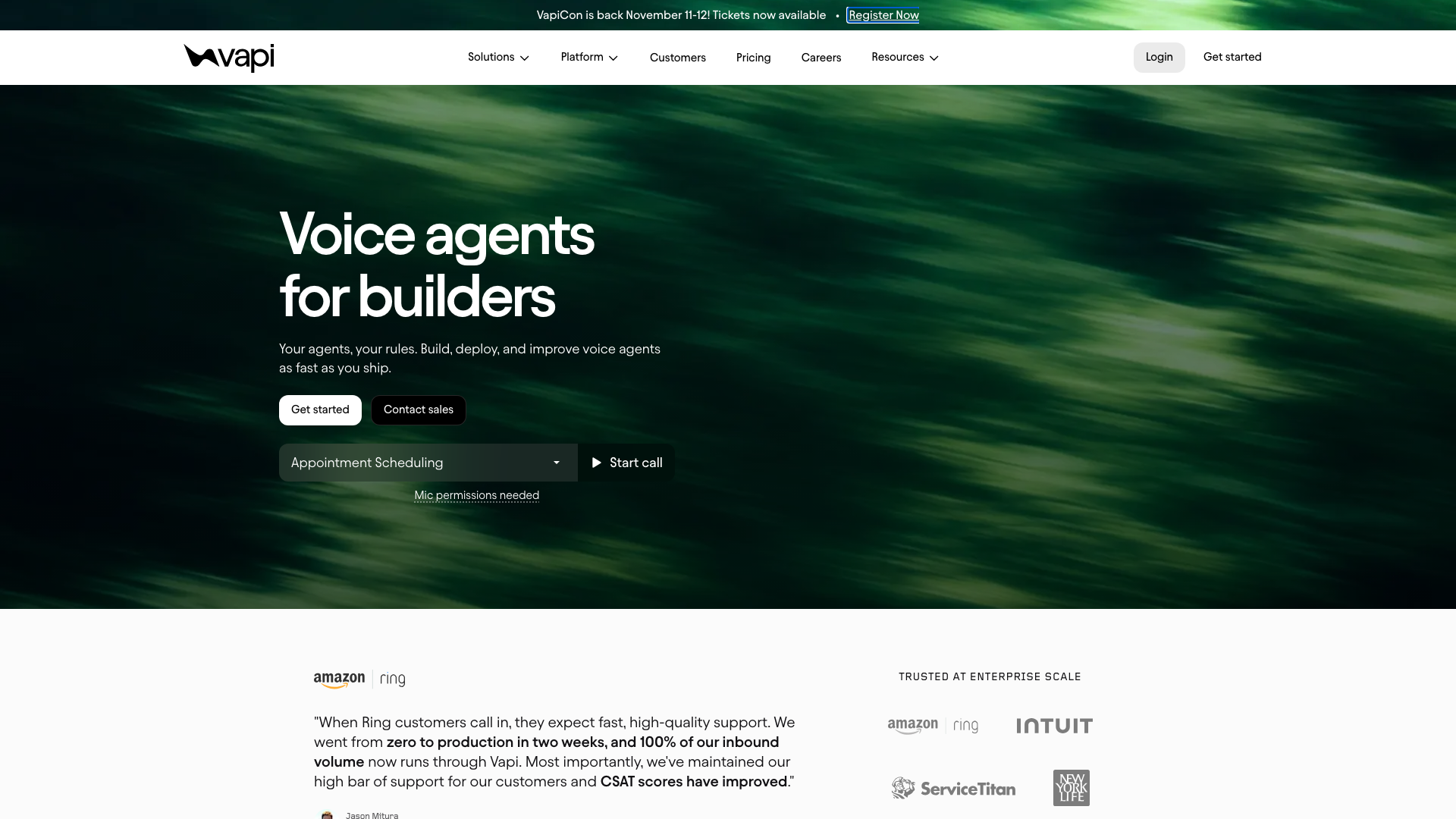
What Vapi does well
Vapi is the most developer-friendly of the hosted voice platforms, and it earned that position. The API is clean, the model configuration reads the way you expect, and the platform genuinely supports bringing your own provider keys rather than forcing every token through its billing, from a catalogue of speech and model vendors wider than anything a single library ships. It raised a $50M Series B in May 2026, has handled over a billion calls, and publishes real customer logos including Amazon Ring. It carries SOC 2, GDPR and PCI DSS, publishes a 99.9% SLA on its Scale tier and runs a public status page. Fallback is a first-class feature: you can configure backup voices, backup transcribers and backup models, and a non-fatal error swaps providers instead of dropping the call. All of that matters, and a library leaves every bit of it to you.
Why teams look for a Vapi alternative
You pay $0.05 a minute even with your own API keys
The Build tier charges $0.05 a minute for the orchestration layer, and that number holds whether your model tokens are billed through Vapi or through your own OpenAI account. Bringing your own key removes the vendor margin on the model, and it leaves the platform fee exactly where it was. The fee covers ten concurrent lines, then each additional line is $10 a month, chat is $0.005 a message, HIPAA $2,000 a month and Zero Data Retention $1,000 a month. Speech, model and telephony each bill separately again.
The total is rarely what stings. What stings is that it arrives on five or six separate meters, and the one you can predict least well is the platform fee, which grows every time someone uses the feature.
Your business logic runs as a webhook Vapi calls
The moment your agent needs to do something the dashboard does not express, Vapi’s answer is a custom LLM server. You expose a public endpoint shaped like /chat/completions, Vapi posts the conversation context to it, and you return a response formatted the way Vapi expects. It works, and it turns the usual arrangement around. That endpoint has to be reachable from the public internet, and the conversation history lives on Vapi’s servers rather than in your process.
For a phone agent that is a reasonable trade. For a voice feature inside a web application it costs you the things you normally get for free: the request arrives from Vapi rather than from the browser, so you re-authenticate the user, reload the session and re-check permissions on every turn, from an endpoint that sits outside your usual middleware.
The browser transport and the turn-taking are Vapi’s
@vapi-ai/web starts a call and streams audio over WebRTC through Daily, whose library it carries as a dependency. That transport is solid and it is also opinionated: it takes over audio handling for the page, and it can conflict with another Daily instance already running there. You control when the call starts, you listen to events for transcripts and speech boundaries, and you render your own UI on top. The turn-taking logic itself lives on the platform, and you tune it through assistant configuration rather than by editing code.
Your audio passes through Vapi’s servers
The audio has to reach the machines running the loop, so every call transits Vapi’s infrastructure. Call data is retained 14 days on the Build tier, and turning retention off is a $1,000 monthly add-on. Most teams never think about it. For an EU team handling recorded voice, or anyone whose data map has to name every processor, adding a US orchestration layer between the browser and the model providers is a conversation with legal that running the loop on your own servers avoids entirely.
You cannot debug the conversation locally
When a call goes wrong, the turn that produced it ran on Vapi’s machines. You get the transcript, the call log and the timings, which is a lot, and you get them after the fact. Reproducing the bad turn means placing another call and hoping it misbehaves the same way, because there is no local process to attach a debugger to and no way to step through the decision that cut the user off mid-sentence.
Latency has the same problem. Vapi reports around 790ms end to end, and on the day a call hangs for two seconds you want to know whether the transcriber, the model or the voice spent them. From outside the pipeline you are reading timings someone else measured.
How Micdrop runs the same loop in your server
One language from the microphone to the model
@micdrop/client runs in the browser and handles the microphone, the speaker, voice activity detection and the connection. @micdrop/server runs in your Node process and orchestrates the agent, the speech-to-text and the text-to-speech. Both are TypeScript, and they share types across the wire. @micdrop/react adds hooks for the states your UI needs to render.
One language means one toolchain. The same linter, test runner, CI and deploy cover the voice pipeline and the rest of the app, and the shape the server sends is the shape the browser expects, checked at build time rather than in a call. Most voice AI libraries are written in Python, so a TypeScript team absorbs one as a second service to run, and we made that the whole comparison against Pipecat.
import { MicdropServer } from '@micdrop/server'import { OpenaiAgent } from '@micdrop/openai'import { GladiaSTT } from '@micdrop/gladia'import { ElevenLabsTTS } from '@micdrop/elevenlabs'import { WebSocketServer } from 'ws'
const wss = new WebSocketServer({ port: 8081 })
wss.on('connection', (socket) => {  new MicdropServer(socket, {    firstMessage: 'How can I help you today?',    agent: new OpenaiAgent({      apiKey: process.env.OPENAI_API_KEY,      systemPrompt: 'You are a helpful assistant',    }),    stt: new GladiaSTT({ apiKey: process.env.GLADIA_API_KEY }),    tts: new ElevenLabsTTS({      apiKey: process.env.ELEVENLABS_API_KEY,      voiceId: process.env.ELEVENLABS_VOICE_ID,    }),  })})
That WebSocket server sits in the same application as your authentication, your ORM and your feature flags. A tool call is a function with a Zod schema that runs in that process, so it queries your database directly instead of travelling back over HTTP.
Your only bill comes from your providers
Micdrop is MIT licensed and published on npm, with no account to create and no service to subscribe to. You bring your own provider keys, the audio goes from your server straight to those providers, and your contract for speech, the model and the voice is with each of them directly.
So a voice feature costs you what those three providers charge, plus the server you were already running. There is no second line that grows alongside them, and nobody can reprice the orchestration layer under you, because the orchestration is a package in your node_modules. At ten times the traffic you pay ten times the provider usage and nothing else.
Any provider, with a backup when it fails
Provider integrations ship for OpenAI, Google Gemini, Mistral, ElevenLabs, Cartesia, Gladia, Gradium and the Vercel AI SDK, and moving from one to another is changing a constructor. A call can also run on one speech-to-speech model, OpenAI Realtime or Gemini Live, in place of separate speech-to-text, model and text-to-speech providers. The browser code stays the same either way.
Outages are handled in the same place. FallbackTTS takes a list of factories and walks down it when a provider stops answering:
import { FallbackTTS } from '@micdrop/server'import { ElevenLabsTTS } from '@micdrop/elevenlabs'import { CartesiaTTS } from '@micdrop/cartesia'
const tts = new FallbackTTS({  factories: [    () =>      new ElevenLabsTTS({        apiKey: process.env.ELEVENLABS_API_KEY,        voiceId: process.env.ELEVENLABS_VOICE_ID,        maxRetry: 2,      }),    () =>      new CartesiaTTS({        apiKey: process.env.CARTESIA_API_KEY,        modelId: 'sonic-3.6',        voiceId: process.env.CARTESIA_VOICE_ID,        maxRetry: 3,      }),  ],})
The pending text is buffered and replayed on the second provider, so the user hears a short pause instead of a dropped call. The same pattern covers speech-to-text and the agent itself.
Every layer of Micdrop is yours to change
Micdrop is open at two levels, the interface you render and the classes underneath it.
The interface is entirely yours, since there is no widget and nothing to restyle. React hooks expose the state locally, conversation and errors included, through useMicdropState, plus live microphone and speaker levels through useMicVolume and useSpeakerVolume, so a waveform reacting to the user’s voice is a few lines rather than a feature request. Voice activity detection is open in the same way, taking 'volume', 'silero', your own implementation passed as an instance, or several combined in an array when you want to tune latency against false positives. Tool calls reach the client too, arriving as entries in the conversation history, so showing what the assistant is doing or asking the user to confirm it is a rendering job rather than an integration.
Underneath, Agent, STT and TTS are abstract classes on an event emitter. Bring your own provider by implementing the interface, or subclass a provided one to override the method you disagree with and keep the others. MicdropServer emits the raw user and assistant audio as it flows, the agent emits every message, tool call and end-of-call decision, and MockAgent runs the whole pipeline in your test suite without spending anything at a provider. When none of that goes far enough, the licence is MIT and the code is yours to fork.
A fully European stack is a configuration change
Running Mistral for the model, Gladia for the transcription and Gradium for the voice keeps every packet of a conversation inside the EU, with no change to the orchestration code. The sovereign stack guide walks through it. Micdrop makes a sovereign architecture possible, and the compliance of your deployment stays yours and your providers’.
The real-time plumbing is already written
Micdrop comes with the details that separate a voice demo from a feature you can ship. Voice activity detection runs in the browser, so audio travels only while someone is speaking, which is what makes a WebSocket enough for a one-to-one call. Semantic turn detection asks the model whether the sentence is finished instead of counting milliseconds of silence, so the assistant stops interrupting people mid-thought. Noise filtering drops the “uh” and the throat clearing before they trigger a model call. Conversation resume rehydrates the agent after a dropped socket, and MicdropRecorder hands you raw PCM buffers tied to each message when you want to keep the audio.
Products already run on this. Raconte.ai conducts voice interviews and is built by Micdrop’s maintainer, which is worth saying out loud when it is cited as proof. Cibli, a recruitment platform where candidates answer out loud, is built by a separate team. Both ship the browser and server packages together.
Vapi and Micdrop in a React Native app
Vapi and Micdrop both put a voice agent in a React Native app. Vapi’s @vapi-ai/react-native mirrors its web SDK: vapi.start(assistantId) joins a Daily WebRTC room, the app streams the microphone for the whole call, and transcription, the model, the voice and the turn-taking run on Vapi’s servers.
Vapi last released that SDK in July 2025. Its README still asks you to switch off React Native’s New Architecture, which recent React Native versions make mandatory, so check the state of the repository before you build a mobile app on it. Vapi’s native SDKs, also built on Daily, are more current: the Swift one was updated in March 2026 and the Kotlin one in December 2025.
Micdrop’s React Native client runs on the New Architecture and streams to the MicdropServer in your own Node process, the one your web app already talks to. Voice activity detection runs on the device, so audio leaves the phone only while the user speaks. The call code is the browser code with a different import. Vapi’s and Micdrop’s React Native SDKs both need native code, so both run from an Expo development build rather than from Expo Go.
The choice on mobile is the same as on the web: where the conversation runs, and who bills the minute. Vapi charges its $0.05 a minute on a call from a mobile app just as on a call from a browser. That fee still pays for the dashboard, the call logs and the SLA, which Micdrop leaves to you on mobile as on the web.
Head to head
Vapi published these prices in August 2026. Voice AI pricing moves fast, so check its pricing page before you commit a budget.
| Vapi | Micdrop | |
|---|---|---|
| Where the conversation runs | Vapi’s infrastructure | Your Node process |
| How you get it | Hosted platform, closed orchestration engine | MIT library on npm |
| Server language | Any, through HTTP webhooks | TypeScript / Node.js |
| Browser transport | WebRTC through Daily | WebSocket, with VAD in the browser |
| React Native | @vapi-ai/react-native, WebRTC through Daily | @micdrop/react-native, WebSocket with VAD on the device |
| Custom logic | An OpenAI-shaped endpoint Vapi calls back | Functions and Zod schemas in your process |
| Extending the built-ins | Assistant configuration, then a webhook | Swap the VAD, subclass any class, fork the code |
| Platform fee | $0.05 / min on Build, custom on Scale | None |
| Provider fallback | Voice, transcriber and model fallback plans | FallbackTTS, FallbackSTT, agent fallback |
| Phone numbers, SIP / PSTN | Yes, US and Canada mainly | Not covered |
| Dashboard, transcripts, logs | Included | Events and hooks, you build the UI |
| Compliance | SOC 2, GDPR, PCI DSS, HIPAA at $2,000 / mo | Determined by your hosting and providers |
| SLA and status page | 99.9% on Scale | You operate it |
| Data retention | 14 days on Build, no-retention at $1,000 / mo | Whatever your database does |
| Community | Large, funded, active Discord | Small, young, one maintainer |
The community gap deserves as much weight as the price gap. Vapi has a Discord full of people who have hit your bug already, and Micdrop does not.
What each option actually costs
Vapi’s Build tier is usage-based: $0.05 a minute of platform fee, 60+ free minutes to start, ten concurrent lines included and $10 per additional line per month, chat at $0.005 a message, and speech and model costs passed through at provider rates or billed to your own keys. Scale is an annual contract with volume-based per-minute pricing and a dedicated account team. HIPAA and Zero Data Retention are add-ons at $2,000 and $1,000 a month.
Micdrop costs nothing to install. You pay speech-to-text, the model and text-to-speech at list price, directly to each provider, plus whatever your server already costs to run. A free tier and an enterprise tier both need a company behind them, and Micdrop is a package.
Which one is cheaper depends on volume and on what you count. At low volume the platform fee is noise, and Vapi’s free minutes cost less than the engineering time a self-hosted pipeline would take. At 30,000 minutes a month, a modest in-app voice feature, the platform fee alone reaches $1,500 before a single second of speech, for orchestration your own server could run. At high volume with phone numbers, compliance requirements and a support contract, the alternative to Vapi’s Scale tier is hiring people to do that work, and the platform is usually the better fit.
Who should choose which
Choose Vapi when your product is phone calls. Inbound and outbound routing, SIP integration into a contact centre, call transfer, voicemail detection and a carrier relationship are the whole platform, and rebuilding them is a company’s worth of work. Choose it when you need SOC 2 or PCI DSS today rather than in two quarters, when an SLA has to appear in a customer contract, when non-engineers need a dashboard to change a prompt, or when the team that will operate the voice feature does not run Node in production.
Choose Micdrop when voice is a feature of a web application you already deploy. The signals are clearest when your backend is TypeScript, when the agent needs your database and your session context on every turn, when per-minute fees scale badly against your unit economics, when your data map cannot easily absorb a US orchestration hop, or when you want to read the code that decides when the user stopped talking.
If you have not built the feature yet, build the first version on Vapi. A weekend on its free minutes tells you more about your prompt, your voice choice and how people actually talk to your product than any architecture decision will. The choice between the two only starts to matter once enough people use the feature for the per-minute fee to show up in your budget. If you already suspect you will move at that point, keep your prompt and your tool logic in your own repository rather than in Vapi’s dashboard, and the move costs you an afternoon instead of a rewrite.
Plenty of teams should use neither. If you have committed to one model vendor and only need a voice loop, a realtime API from that vendor has fewer moving parts than Vapi. When you later want the microphone, turn-taking and transcripts handled for you, Micdrop can run that same API behind its own client. If your backend is Python and you need telephony, Pipecat and LiveKit Agents are the serious answers, and we ranked the whole field in open source voice agent frameworks.
What adopting Micdrop involves
Starting fresh
The Getting Started guide gets a browser talking to a Node server in about five minutes: install the two packages, give MicdropServer an agent, a speech-to-text provider and a voice, and open a WebSocket. The only accounts you create are at the providers.
Wiring that into a real application, with your authentication, your session and your own UI around it, is an afternoon’s work rather than a sprint. Storing transcripts, showing call history to your team and alerting when a provider degrades are yours to write, on top of a database and a logger you probably already run. Message persistence and the recording hooks surface the events, and the interface on top of them is yours.
Coming from Vapi
There is no import tool, so you rebuild the assistant by hand. That is less work than it sounds, because most of what you built is prompt text and business logic that carries straight across.
Your system prompt moves over unchanged, into the systemPrompt of the agent. Micdrop integrates with many of the same speech and model vendors, so a stack on OpenAI, Gemini, Mistral, ElevenLabs, Cartesia or Gladia transfers as is and the same voice ID keeps working. The tools are the real work: each Vapi function becomes a function registered on the agent with a Zod schema, and the body usually gets shorter, because it now runs where your database connection already lives instead of behind an HTTP round trip. If you built a custom LLM server, that logic collapses into the agent itself and the endpoint disappears.
On the browser side, @micdrop/client replaces @vapi-ai/web, and Micdrop.start({ url }) replaces vapi.start(assistantId), pointing at your own server rather than at an assistant on the platform. Both SDKs surface the same conversational moments (call start and end, speech boundaries, transcript messages), so the UI you already built maps across with renamed handlers rather than a rewrite. In a React Native app, @micdrop/react-native replaces @vapi-ai/react-native the same way.
Rebuilding the pipeline itself takes hours. Rebuilding the dashboard and the call history takes longer, since they stop being included the day you leave. Run both stacks in parallel behind a feature flag, and keep the Vapi assistant answering until the traffic has moved.
Frequently asked questions
Who are the main competitors of Vapi?
Vapi competes on two fronts. Among hosted platforms, Retell AI, Bland and Synthflow cover similar ground, with Retell strongest on contact-centre integrations and both Bland and Synthflow offering EU hosting. Telnyx runs voice agents on its own carrier network. Twilio ConversationRelay handles the call and the speech, then passes the text to a model server you write. These hosted platforms differ widely on price per minute, telephony and EU hosting. Among self-hosted frameworks, Pipecat and LiveKit Agents are the two largest, both Python-first. Micdrop covers the narrower case of a voice conversation inside a TypeScript web application.
What are some free alternatives to Vapi?
Pipecat (BSD 2-Clause, Python), LiveKit Agents (Apache 2.0, Python and Node), Dograh (BSD 2-Clause, with a visual workflow builder) and Micdrop (MIT, TypeScript) are all free to install and self-host, with no per-minute platform fee. Free applies to the software rather than the calls: you still pay speech-to-text, the model and text-to-speech at each provider’s list price, and you pay for the server that runs the pipeline. The saving against a hosted platform is the orchestration fee and the vendor margin, which is real money at volume and irrelevant at ten minutes a day.
Is there an open source alternative to Vapi?
Yes, several, split between self-hostable platforms and code-first frameworks. Dograh is the closest match to Vapi itself: BSD 2-Clause, self-hostable with one Docker command, with a visual workflow builder and telephony integrations, so it replaces the product rather than only its engine. Pipecat, LiveKit Agents and Micdrop are code-first frameworks that replace the orchestration and leave the dashboard, the phone layer and the deployment to you. You install them on your own servers, and the managed clouds Pipecat’s and LiveKit’s maintainers sell put you back on a per-minute meter. Whichever you pick, you now operate what Vapi was operating for you.
Is Retell AI better than Vapi?
Neither is better across the board. Vapi charges $0.05 a minute of orchestration on top of your provider bills. Retell’s pay-as-you-go lands between $0.07 and $0.31 a minute, with the model billed by the clock rather than by the token, so a call where the user thinks before answering costs the same as one where they talk throughout. Retell’s compliance documentation also states that it operates no services within the European Union, so a European product handling recorded voice has one more US processor to justify. Both run the conversation on their own infrastructure, and that is the part a self-hosted library takes back. The Retell article makes the same comparison from Retell’s side.
Can I use Vapi without paying the per-minute fee?
No. The $0.05 a minute on the Build tier pays for Vapi’s orchestration layer and applies whether or not you bring your own provider keys. Your own keys buy the model tokens at provider price. The orchestration fee stays. Avoiding that fee entirely means running the orchestration yourself, which is what a self-hosted framework is for.
Should I start a new project on Vapi or on a self-hosted framework?
It depends on which unknown is bigger. If you are still unsure the voice feature will hold up with real users, Vapi’s free minutes answer that in a weekend, before you commit to any architecture. If the feature is a screen inside a web application and your backend already runs Node, starting on a library saves you a migration you can already see coming. Either way you can change your mind later. Rebuilding the pipeline takes hours, and what you throw away is the dashboard or the logging you built on top of it.
Does Micdrop support phone calls?
No. Micdrop connects a browser or a React Native app to your Node server over a WebSocket, and it has no SIP, PSTN or telephony layer. If your agent has to answer a phone number, a hosted platform like Vapi or a telephony-capable framework like Pipecat, LiveKit Agents or Jambonz is the right tool. Micdrop covers a user talking to your application, in a browser tab or in your mobile app.
How long does it take to migrate from Vapi to Micdrop?
Rebuilding the pipeline takes a few hours. The system prompt and the provider configuration transfer almost unchanged, and the tools need rewriting as typed functions in your server, which usually makes them shorter. The work that actually takes time is replacing what the platform included: call logging, transcript storage and any dashboard your team relied on. Run both behind a feature flag before cutting over.
The two are good at different jobs. Vapi runs the conversation for you, answers phone numbers, carries SOC 2 and PCI DSS and gives you a dashboard on day one. If your product is phone calls, or you need those certifications this quarter, pay the five cents a minute and stop reading comparisons.
Micdrop fits the other case, a voice mode inside a product you already run. The conversation runs in your own Node server, so you can read it, extend it and debug it like the rest of your code, and you pay your providers directly with nothing added on top. The first working call takes about five minutes with the Getting Started guide.


