Local Speech to Text in Node: Whisper, faster-whisper, Vosk, Parakeet
Whisper transcribes in Node with no API key but pads every sentence to thirty seconds. Vosk, Moonshine and Parakeet read audio at its real length.
September 15, 2026
Godefroy de CompreignacUpdated on October 30, 2026
Key takeaways
- Whisper pads every sentence to thirty seconds of audio, so a short sentence costs almost as much to transcribe as a long one.
- Choose a Whisper checkpoint by the language of the call before its size. A small checkpoint fine-tuned on French is more accurate in French than the much heavier large-v3-turbo.
- faster-whisper and whisper.cpp run the same Whisper weights with less compute and memory, but by default they still pad every sentence to thirty seconds.
- Moonshine and Parakeet skip Whisper's thirty second padding and run in Node through the sherpa-onnx native addon. Kyutai STT runs outside Node, on PyTorch, MLX or its own Rust server.
- Hosted transcription costs $0.18 to $0.75 per hour of audio. Running it locally is worth it for privacy, for offline use, or on a server with CPU to spare.
To transcribe speech locally in a Node server, with no API key, no bill per minute and no audio leaving the machine, start with Whisper. It installs with one npm command and is accurate enough for a voice call on a laptop CPU. It is slow on short sentences, though, because it reads thirty seconds of audio whatever the length of the sentence. Outside English, a Whisper checkpoint fine-tuned on the language of the call is more accurate than a bigger generic one. Parakeet, Moonshine and Vosk read only the audio the user spoke. Pick Parakeet for the lowest error rate in English, and Moonshine or Vosk for the smallest model. For long recordings where word-level timestamps and batch transcription matter, WhisperX adds voice activity detection and forced alignment to Whisper, though it runs as a Python process alongside Node.
We measured every @micdrop/whisper latency on CPU, with the model already loaded, on a MacBook Pro M2 with 24 GB of memory. The benchmark of a fully local voice pipeline ran on the same machine.
Whisper in Node takes 320 ms to 3.8 s on a short sentence
@micdrop/whisper runs Whisper inside the Node process through Transformers.js and ONNX Runtime. The weights download on first use, in q8 by default, then every call in the process shares them.
| Checkpoint | Parameters | Download in q8 | On a 3 second sentence | Word errors in French |
|---|---|---|---|---|
tiny | 39M | ~45 MB | ~320 ms | Not measured |
base | 74M | ~85 MB | ~440 ms | 25% |
small | 244M | ~250 MB | ~1000 ms | 22% |
turbo | 809M | ~850 MB | ~3800 ms | 17% |
french | 244M | ~390 MB | ~1100 ms | 2% |
Word errors were counted on five French sentences with proper nouns, numbers and homophones. turbo is OpenAI’s large-v3-turbo, which keeps the large-v3 encoder and cuts the decoder from 32 layers to 4. OpenAI’s code and weights are MIT and the french fine-tune is Apache 2.0, so every checkpoint can be used commercially.
import { WhisperSTT } from '@micdrop/whisper'import { createReadStream } from 'fs'
const stt = new WhisperSTT({ model: 'base', language: 'en' })
stt.on('Transcript', (text) => console.log(text))
// Raw PCM, 16 bits, 16 kHz, monostt.transcribe(createReadStream('speech.pcm'))
The class works on its own, without a server or a WebSocket, so you can measure a checkpoint on your own hardware. Pass it to MicdropServer and it transcribes each sentence of a live call. Run the server without an agent or a voice and you get a dictation server.
Whisper pads every sentence to thirty seconds
Whisper was trained on thirty second windows, so its encoder always receives thirty seconds of audio. A two second sentence gets 28 seconds of silence appended before the encoder runs. The encoder therefore does the same work for every sentence. Only the decoder, which writes the words, takes longer when more was said.
Because of that padding, even tiny takes around 320 ms on a three second sentence, and small about a second. A voice call is mostly short answers such as “yes”, “Thursday works” or “can you repeat that”. Whisper still encodes each of them as thirty seconds of audio.
The LLM starts its answer once the transcript is ready, so the time Whisper spends adds to the user’s wait for a reply. With Whisper base, a local LLM and a local voice, the first word reaches the user after 0.8 to 1.9 seconds, about 440 ms of it spent transcribing.
You can still save time with two settings. Set language and Whisper skips language detection. A short sentence then also comes out in the right language. The warmup option saves more and is on by default. With it, @micdrop/whisper loads the weights when you construct the class and runs one inference on silence while the call is being set up, so the slow first run is over before the user speaks.
faster-whisper and whisper.cpp run the same weights on a faster runtime
Both projects run OpenAI’s weights, so they transcribe as accurately as the original while using less compute and memory.
faster-whisper, from SYSTRAN, runs Whisper on CTranslate2. Its README reports a benchmark of the small checkpoint on an Intel i7-12700K with 8 threads over 13 minutes of audio. The OpenAI implementation takes 6 min 58 s and 2335 MB of memory. faster-whisper takes 2 min 37 s in fp32, and 1 min 42 s with 1477 MB in int8. On a GPU with large-v2, OpenAI’s code takes 2 min 23 s and faster-whisper 59 s. faster-whisper is under MIT, with Silero VAD built in. Since it is a Python library, you run it from Node as a separate service and send it audio over HTTP or a WebSocket.
whisper.cpp, also under MIT, rewrites Whisper in C and C++ with no dependency. Its model files weigh 75 MiB for tiny, 142 MiB for base and 466 MiB for small, and use around 273, 388 and 852 MB of memory once loaded. You can call whisper.cpp from Node directly, in three ways:
- The repository ships a Node addon under
examples/addon.node, built with cmake-js and meant as a reference rather than a published package. nodejs-whisperon npm wraps whisper.cpp for Node and was last published in August 2026.@kutalia/whisper-node-addonships prebuilt binaries with GPU support.
Both runtimes pad to thirty seconds by default, like the original, so a short sentence still costs a full window. They make each of those thirty seconds cheaper to encode. A server transcribing many calls at once gains the most. Micdrop already runs ONNX weights quantized to q8, so on a laptop expect a smaller gain than the one faster-whisper measured against OpenAI’s Python code.
WhisperX batches long recordings and aligns words to the audio
WhisperX uses faster-whisper for recognition, then adds voice activity detection, batched transcription and forced alignment with a phoneme model. It adds a start and end time to each aligned word. Use WhisperX’s VAD and alignment for long recordings and subtitle workflows. Compared with faster-whisper alone, WhisperX adds VAD, batching and alignment models. Compared with whisper.cpp, it needs a Python runtime and separate language-specific alignment models. Researchers evaluated this approach in a study of time-accurate transcription for long-form audio.
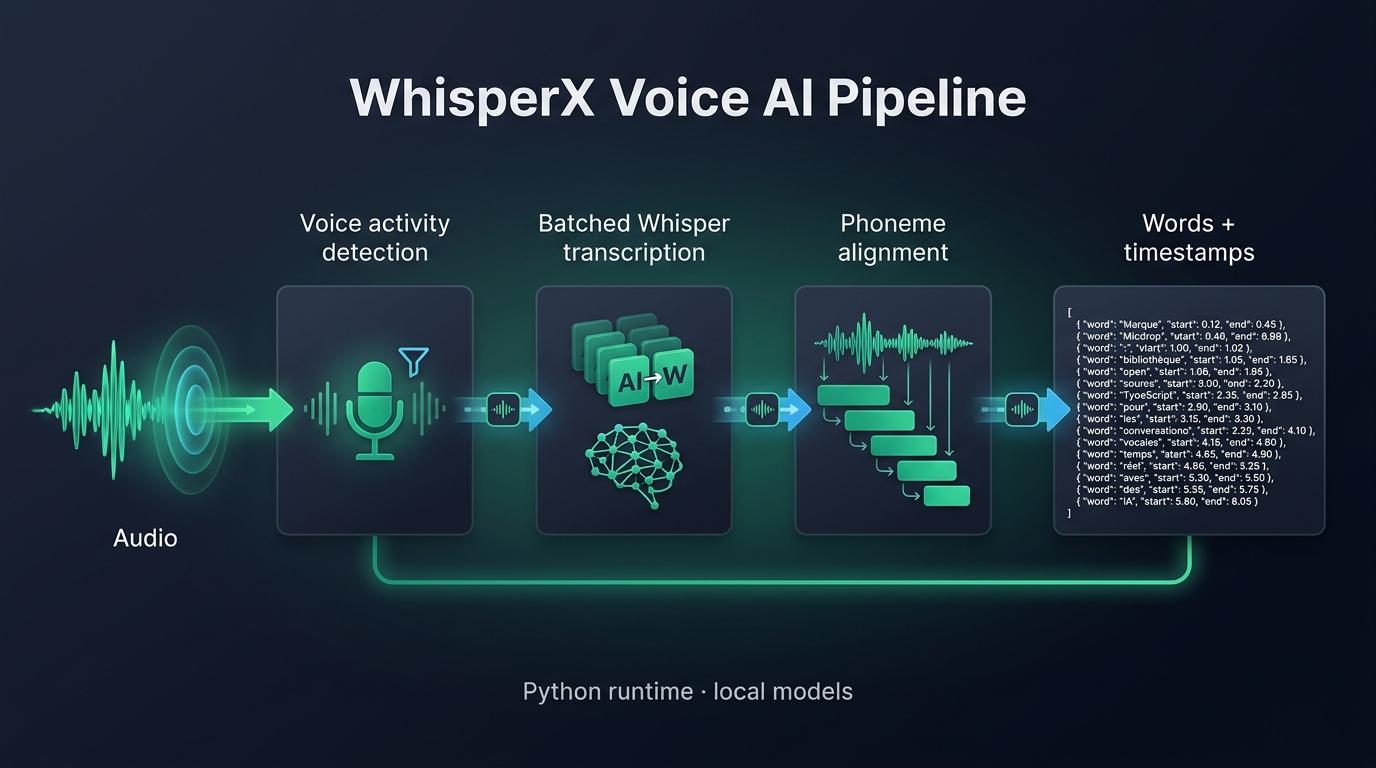
A Node server can run WhisperX’s Python CLI as a child process. Install WhisperX in a Python environment with pip install whisperx, then run its whisperx command. This example writes the transcript to a JSON file:
import { spawn } from 'node:child_process'import { once } from 'node:events'
const child = spawn('whisperx', [  'recording.wav',  '--model', 'small',  '--device', 'cpu',  '--compute_type', 'int8',  '--output_dir', './transcripts',  '--output_format', 'json',], { stdio: 'inherit' })
const [code] = await once(child, 'close')if (code !== 0) throw new Error(`WhisperX exited with code ${code}`)
WhisperX downloads model weights on the first run and needs a separate alignment model for the recording’s language. Its code uses the BSD 2-Clause license, while model weights can have separate terms, so check each model before commercial use. CPU mode works with --device cpu. GPU acceleration needs a compatible CUDA setup. Its batched decoding uses VAD segments, and its CLI offers options for carrying context between segments. Words missing from the alignment model’s vocabulary may lack timestamps, and WhisperX can have trouble with overlapping speech or mislabel speakers. Diarization also needs the optional speaker model, a Hugging Face access token and acceptance of that model’s terms. For a short live call, Whisper in Node or whisper.cpp avoids the Python runtime and alignment stages. For long recordings where word timing or speaker labels matter, WhisperX adds those stages at the cost of extra models and setup.
Vosk, Moonshine, Parakeet and Kyutai STT read audio at its real length
Vosk, from Alpha Cephei, is the oldest of the four. It is built on Kaldi and streams words while the user is speaking. Its small English model weighs 40 MB and makes 9.85% word errors on LibriSpeech test-clean, against 5.69% for the 1.8 GB large one. The library is Apache 2.0, while a few models carry AGPL or non-commercial licenses. Its npm package vosk was last published in May 2022 and depends on ffi-napi, so expect some work to build it on a recent Node.
Moonshine, from Moonshine AI, was trained without the thirty second padding. Its paper reports five times less compute than Whisper tiny.en on a ten second segment, at the same word error rate. The current streaming models also cache the encoder and decoder state between chunks. The English model comes in three sizes, Tiny at 34M parameters, Small at 123M and Medium at 245M. Streaming models cover Arabic, German, Japanese, Mandarin, Spanish, Tagalog and Vietnamese. Moonshine publishes the English and streaming models under MIT, and the older non-English models under a non-commercial community license.
NVIDIA Parakeet is the most accurate open model of the four in English. parakeet-tdt-0.6b-v2 covers English and v3 covers 25 European languages with automatic detection. Both have 600M parameters and are published under CC-BY 4.0. v2 averages 4.70% word errors on the Hugging Face Open ASR leaderboard, against 5.78% for Whisper large-v3, and processes audio more than ten times faster on the leaderboard’s GPU.
Kyutai STT, from the Kyutai lab, was designed for streaming from the start. stt-1b-en_fr handles English and French with half a second of delay. The larger stt-2.6b-en handles English alone, with 2.5 seconds of delay. Kyutai publishes the weights of both under CC-BY 4.0.
All four take more work to set up in Node than Whisper, which installs with one npm command:
- Moonshine and Parakeet run through
sherpa-onnx-node, a native addon under Apache 2.0 with examples for both, Silero VAD included. Transformers.js lists both architectures too, with an ONNX export of Moonshine published on Hugging Face. - Vosk runs through its
vosknpm package, once you getffi-napito build. - Kyutai STT has no ONNX export, so it runs outside Node, on PyTorch, on MLX on Apple Silicon, or in Kyutai’s Rust
moshi-server. Your Node server talks tomoshi-serverover a WebSocket.
Whisper is the only model here with a latency measured on a laptop CPU. To use Vosk, Moonshine, Parakeet or Kyutai STT in a call, wrap its runtime in a class that implements the speech to text interface, with a transcribe() method that receives the audio stream and emits a Transcript event.
graph TD
    A[Language of the call] --> B{English only?}
    B -->|Yes| C{Hardware}
    C -->|Laptop CPU, one npm install| D[Whisper base]
    C -->|Server, lowest error rate| E[Parakeet v2 via sherpa-onnx-node]
    C -->|Smallest possible model| F[Moonshine Tiny or Vosk small]
    B -->|No| G{A Whisper checkpoint fine-tuned on it?}
    G -->|Yes| H[That checkpoint, exported to ONNX]
    G -->|No, a European language| I[Parakeet v3]
    G -->|No| J[A hosted API]
A checkpoint fine-tuned on one language is more accurate than a heavier generic one
The generic Whisper checkpoints learned around a hundred languages at once, so they are less accurate outside English. Over the same five French sentences, on the same machine:
| Checkpoint | Latency | Word errors |
|---|---|---|
base | ~440 ms | 25% |
small | ~1000 ms | 22% |
turbo | ~3800 ms | 17% |
french | ~1100 ms | 2% |
french is whisper-small fine-tuned on French Common Voice. It runs about as fast as small and makes fewer errors in French than turbo, which downloads twice as much and takes more than three times as long. Part of the gap comes from numbers. The generic checkpoints write “17h30” where the French one writes “dix-sept heures trente”.
const stt = new WhisperSTT({ model: 'french', language: 'fr' })For another language, search the Hugging Face hub for a whisper-small fine-tuned on it and exported to ONNX, then pass its repository id as model. Try that before a larger generic checkpoint, which slows down every sentence, short ones included. The local STT page of the docs sums up which checkpoint to run for each language.
Hosted transcription costs $0.18 to $0.75 per hour of audio
Use a hosted API when the server is short on CPU, or when the call switches between languages no local checkpoint covers. Micdrop ships integrations for OpenAI, Gemini, Mistral and Gladia, and each one replaces WhisperSTT while the agent and the voice stay as they are. They cost between $0.18 and $0.75 an hour of audio in September 2026, and they differ in languages, accuracy and time to the final transcript. Mistral and Gladia fit a sovereign voice pipeline.
The models compared on latency, size, license and Node support
| Model | Languages | Latency on a 3 s sentence | Size | License | From Node |
|---|---|---|---|---|---|
Whisper base | ~100 | ~440 ms | 85 MB in q8 | MIT | @micdrop/whisper |
Whisper french | French | ~1100 ms | 390 MB in q8 | Apache 2.0 | @micdrop/whisper |
| faster-whisper | Same as Whisper | Not measured here | Same as Whisper | MIT | Python service |
| whisper.cpp | Same as Whisper | Not measured here | 142 MiB for base | MIT | Addon or nodejs-whisper |
| Vosk small | 20+, one model per language | Not measured here | 40 MB in English | Apache 2.0, most models | vosk, last published in 2022 |
| Moonshine | English and 7 others | Not measured here | 34M to 245M params | MIT, community license for some | sherpa-onnx-node |
| Parakeet TDT 0.6B | English (v2), 25 (v3) | Not measured here | 600M params | CC-BY 4.0 | sherpa-onnx-node |
| Kyutai STT | English and French (1B) | Not measured here | 1B and 2.6B params | CC-BY 4.0 | moshi-server over a WebSocket |
| WhisperX | Varies by alignment model | Not measured here | Whisper + alignment models | BSD 2-Clause | Python CLI started from Node |
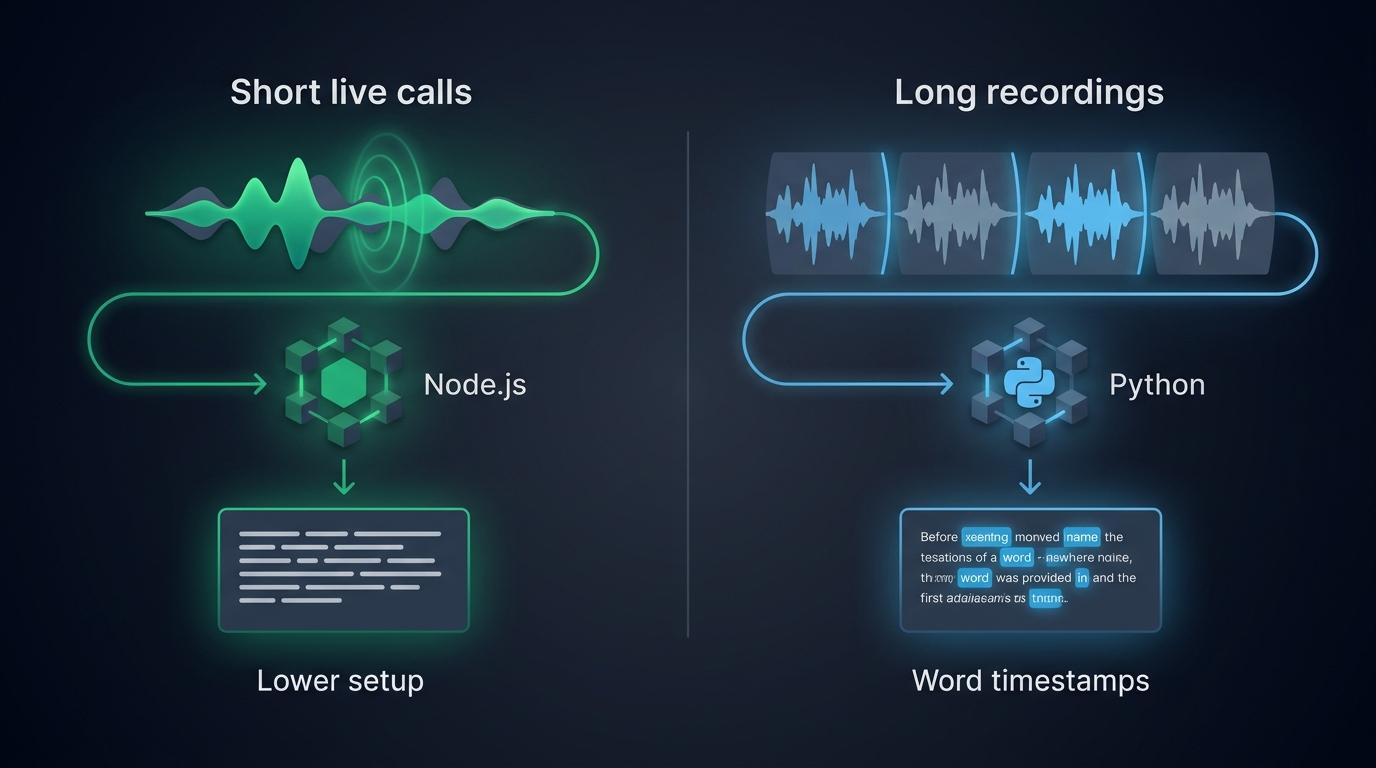
Start with Whisper base for an English call, since it is the only English option here that installs with one npm command and has a measured latency on a laptop. For a call in another language, move to a checkpoint fine-tuned on that language. Look at Parakeet once transcription runs on a server and the English error rate matters more than setup time. Pick Moonshine Tiny or Vosk when the model has to stay as small as possible. Use WhisperX for long recordings when word-level timestamps, batching or diarization justify a separate Python runtime.
To switch models, replace the transcription class. The agent and the voice stay as they are. The voice can run on the same machine too, with a local text to speech model. Whisper base, Piper and an LLM served by Ollama give you a local voice agent that answers in about a second on a MacBook Pro M2. You can compare every transcription and voice provider or start a first voice call in about five minutes.
Frequently asked questions
What is the best local speech-to-text model?
It depends on the language and the hardware. On a laptop CPU in Node,
Whisper base is the simplest start in English, at around 440 ms on a three
second sentence with one npm install. For another language, a Whisper
checkpoint fine-tuned on it is more accurate than a larger generic one: the
French whisper-small makes 2% word errors where large-v3-turbo makes 17%.
On a server, pick NVIDIA Parakeet TDT 0.6B v2, which averages 4.70% word errors
in English on the Open ASR leaderboard, against 5.78% for Whisper large-v3.
Is there a free alternative to Whisper?
Yes, four models run on your own hardware at no cost per minute. Vosk and most of its models are Apache 2.0, Moonshine’s English and streaming models are MIT, and NVIDIA and Kyutai publish the weights of Parakeet and Kyutai STT under CC-BY 4.0. faster-whisper and whisper.cpp are free too. They keep the Whisper model and run it on a faster runtime.
Is there a free speech-to-text?
Every model you run yourself is free to use: Whisper, faster-whisper, whisper.cpp, Vosk, Moonshine, Parakeet and Kyutai STT. You pay for the machine instead. Check the license of the weights too, since some Vosk and Moonshine models forbid commercial use. Among hosted APIs, Gladia gives a new account a one-time €50 credit. Paid transcription starts at $0.18 per hour of audio with Mistral and OpenAI.
Can Whisper do live transcription?
Yes, through a wrapper. Whisper reads a fixed thirty second window and
keeps nothing between calls, so a live wrapper re-runs it on overlapping chunks.
whisper.cpp ships a whisper-stream example that re-transcribes every half
second, WhisperLive wraps faster-whisper in a WebSocket server, and
whisper_streaming reports about 3.3 seconds of latency on long speech. A
voice call needs no wrapper, since voice activity detection cuts the audio
into sentences and Whisper transcribes each one when the user stops
speaking.
Is whisper.cpp faster than faster-whisper?
They are two runtimes for the same Whisper weights, built for different
platforms. faster-whisper is a Python library on CTranslate2. Its README
reports the small checkpoint running four times faster than OpenAI’s code
on a CPU in int8. whisper.cpp is written in C and C++ with no dependency, runs on almost any device
and reaches Node through an addon. Both keep Whisper’s thirty second window by
default, so pick by where your code runs: faster-whisper for a Python
service, whisper.cpp to stay inside a Node or native process.

