Cartesia vs ElevenLabs for a real-time voice agent
We compare Cartesia Sonic 3.6 with ElevenLabs Flash and v4 Turbo on latency, voices, price and concurrency, then run both in one TypeScript voice agent.
October 1, 2026
Godefroy de CompreignacKey takeaways
- For a voice agent, the comparison is Cartesia Sonic 3.6 against ElevenLabs Flash v2.5 or Eleven v4 Turbo. Cartesia stops serving sonic-turbo and sonic-2 after October 20, 2026.
- Both vendors publish a latency test they win, so measure them yourself from the region you deploy in. Even the ElevenLabs test has Sonic 3.6 and v4 Turbo both starting to speak in under 300 ms.
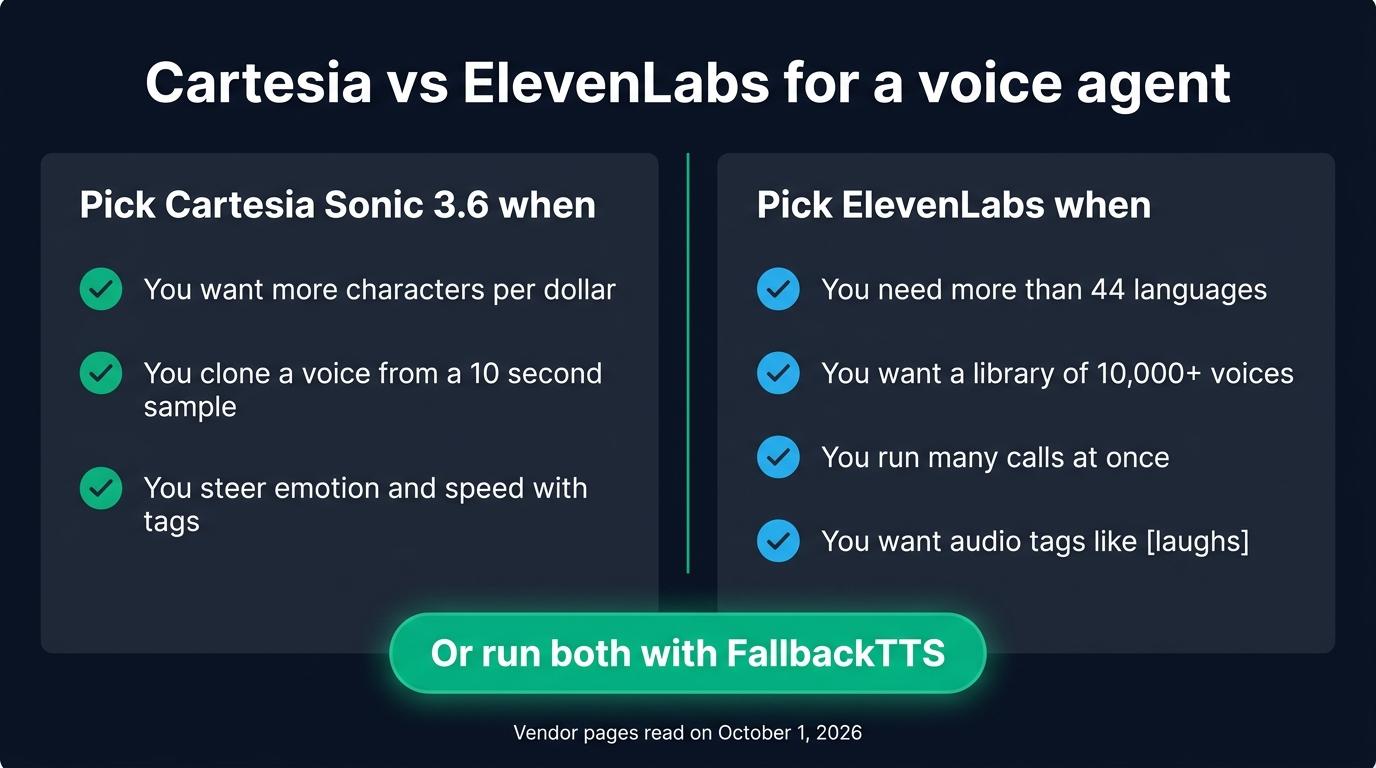
- Eleven v4 Turbo covers more languages (90+, against 44 on Sonic 3.6 and 32 on Flash) and acts out audio tags. Cartesia clones a voice from 10 seconds of audio and takes emotion and speed tags.
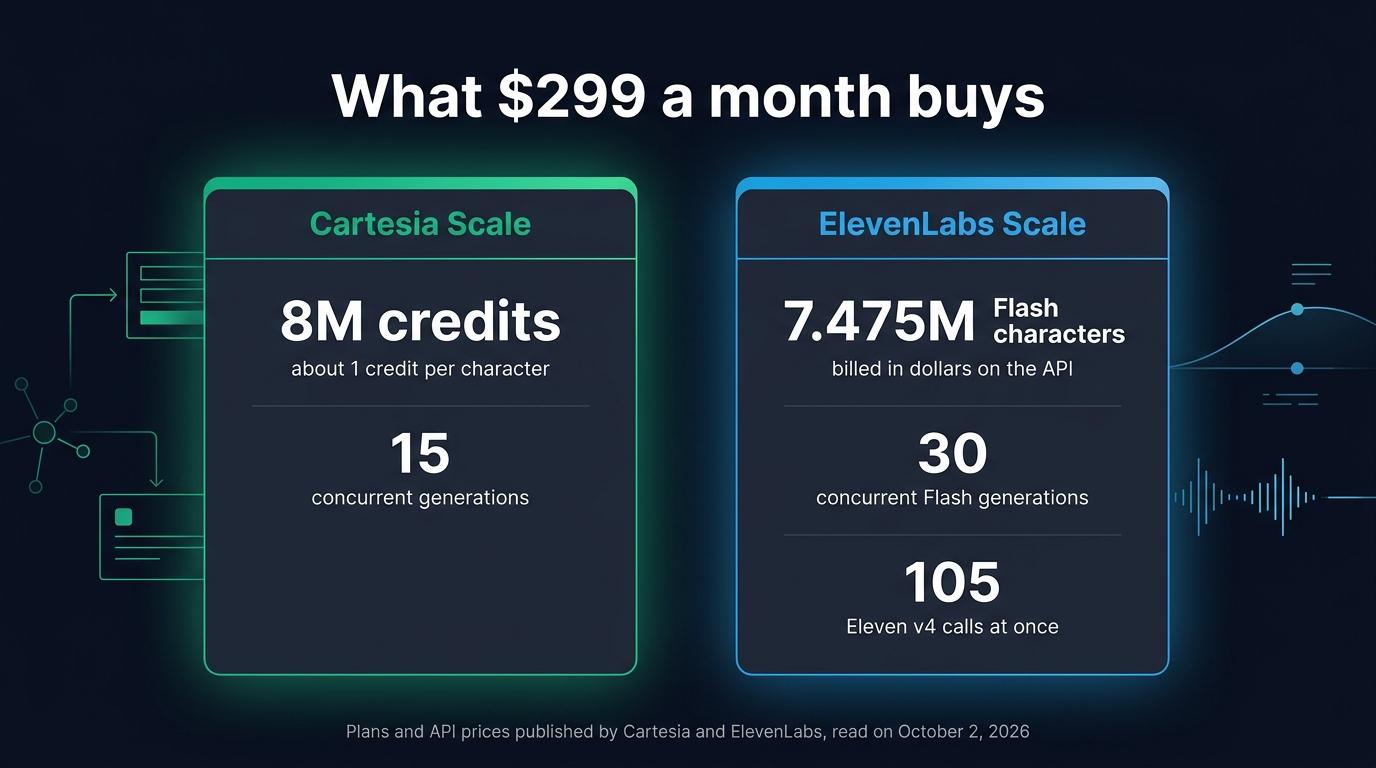
- Cartesia and the ElevenLabs API cost about the same per character. At $299 a month, Cartesia Scale covers about 8 million characters with 15 concurrent generations, while ElevenLabs Scale covers 7,475,000 Flash characters with 30 Flash generations or 105 Eleven v4 calls at once.
- You can keep both: FallbackTTS in Micdrop switches to the second engine when the first one fails and replays the text that was never spoken.
Cartesia and ElevenLabs both sell a streaming text to speech API fast enough for a real-time voice agent. Which one to pick depends on what limits your agent. Pick Cartesia Sonic 3.6 for more characters at the same monthly price and voice cloning from a 10 second sample. Pick ElevenLabs when you need more languages, a bigger voice library, more calls at once on the same budget, or the audio tags of Eleven v4 Turbo. Latency matters less than it seems. Each vendor publishes a benchmark it wins. Even in the ElevenLabs test, Sonic 3.6 and v4 Turbo both start speaking in under 300 ms.
This comparison covers the models a voice agent actually uses: Cartesia Sonic 3.6 on one side, ElevenLabs Flash v2.5 and Eleven v4 Turbo on the other. Every price and limit below was read on the vendors’ pages on October 1, 2026, unless another date is given. OpenAI, Gemini, Gradium and local models are compared with the other alternatives to ElevenLabs for a TypeScript voice agent.
The short answer
| Cartesia Sonic 3.6 | ElevenLabs Flash v2.5 | ElevenLabs Eleven v4 Turbo | |
|---|---|---|---|
| Model ID | sonic-3.6 | eleven_flash_v2_5 | eleven_v4_turbo |
| Published latency | Under 90 ms | About 75 ms of inference | About 100 ms of inference, 150 ms to first speech |
| Languages | 44 | 32 | 90+ |
| Expressive control | Emotion, speed and volume tags | Voice settings only | Audio tags such as [laughs] |
| Instant voice cloning | From 10 seconds of audio | 1 to 2 minutes recommended | 1 to 2 minutes recommended |
| Concurrency on the $299 plan | 15 generations | 30 generations | 105 calls |
| WebSocket | One connection, one context per answer | Text to Speech WebSocket | Text to Dialogue WebSocket, one session per call |
Cartesia’s model list changed this summer. Sonic 3.6 came out on August 27, 2026, and Cartesia stops serving sonic-turbo and sonic-2 after October 20, 2026. An agent still configured with modelId: 'sonic-turbo' has to move to sonic-3.6 before that date. The Sonic 3.6 docs say it is backwards compatible with Sonic 3.5.
Both vendors publish a latency test they win
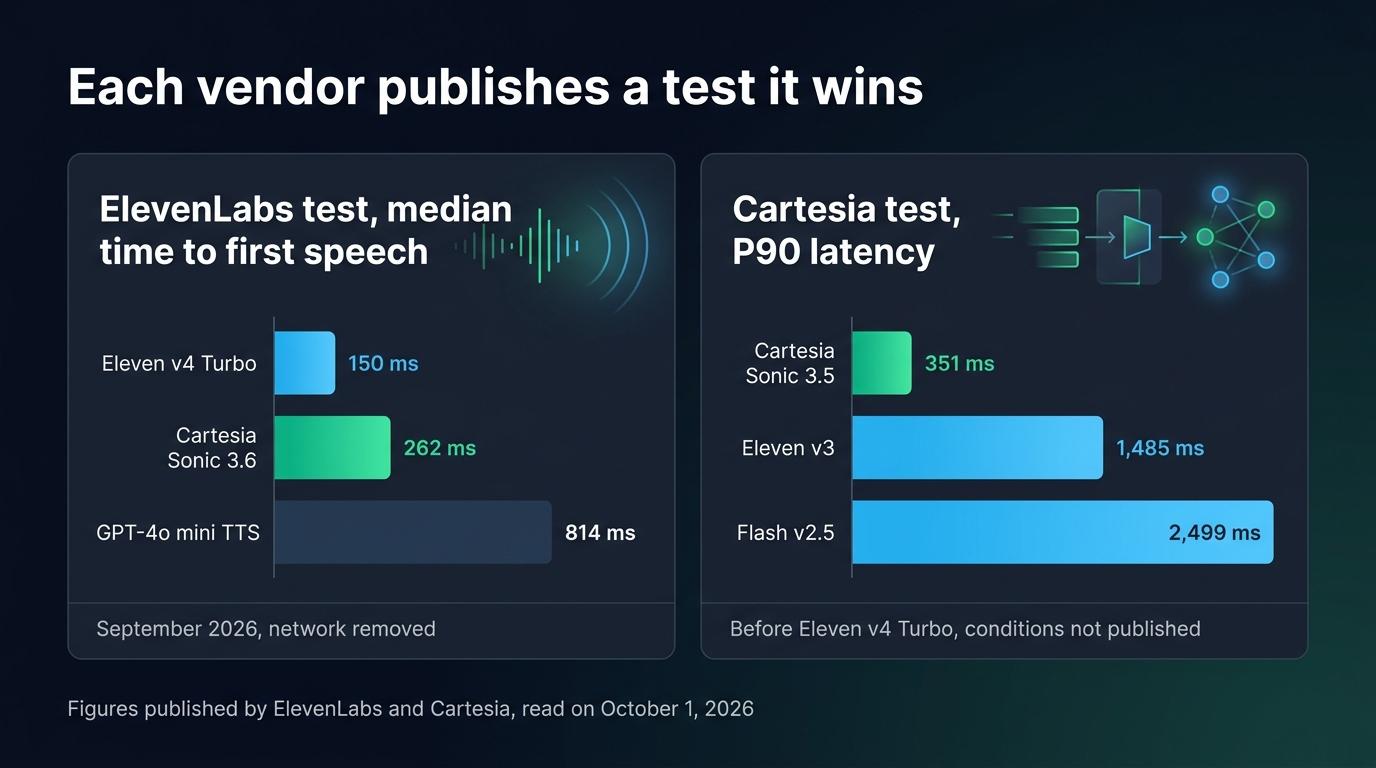
ElevenLabs gives Flash v2.5 about 75 ms of inference and v4 Turbo about 100 ms, network excluded, on its models page. When it announced Eleven v4, ElevenLabs compared the time to first speech of v4 Turbo with Cartesia and OpenAI. It puts v4 Turbo at a median of about 150 ms, against 262 ms for Cartesia Sonic 3.6 and 814 ms for OpenAI’s GPT-4o mini TTS. ElevenLabs ran that test in September 2026, with identical scripts and default settings, and removed the network latency for every system.
Cartesia tells the opposite story. It promises a Sonic latency under 90 ms and gives a P90 latency of 351 ms for Sonic 3.5, against 2,499 ms for Flash v2.5 and 1,485 ms for Eleven v3. Cartesia published that comparison before v4 Turbo and does not say how it ran the test.
The two tests measure different things. ElevenLabs reports a median without the network, while Cartesia reports the 90th percentile, the slow calls a user remembers. Each vendor picked the measure it wins on. Neither figure is what your user hears. Your user also waits for the trip between your server and the vendor, plus the vendor’s queue at that moment.
Our own figures cover ElevenLabs only. On launch day, we streamed Eleven v4 Turbo in a voice agent and heard the first audio 138 ms after the first word, with the text sent word by word and a flush at the end of every sentence.
Latency also matters when the user interrupts. On Cartesia, the client cancels the answer with one message on the open connection. Eleven v4 Turbo has no message to stop a synthesis, so the client closes the connection and opens a new one, which took about 90 ms in our tests. On Flash v2.5, the client keeps the connection, flushes it and throws away the audio of the old answer.
Voices, languages and cloning
ElevenLabs has more voices, and more languages on v4 Turbo. Eleven v4 Turbo speaks more than 90 languages and Flash v2.5 speaks 32, against 44 for Sonic 3.6. The ElevenLabs voice library holds more than 10,000 voices shared by its community. Cartesia does not publish the size of its own.
Cartesia is ahead on cloning. Its instant clone starts from 10 seconds of audio. A sample of up to 60 seconds helps Sonic 3.6 keep the accent. ElevenLabs recommends one to two minutes of audio for an instant clone, and 30 minutes or more for a professional clone, which needs a Creator plan or above. Cartesia offers professional clones from its $49 Startup plan.
The two vendors give the voice its emotion in different ways:
- Eleven v4 Turbo performs audio tags written by the LLM, such as
[laughs],[whispers]or[sighs], along with sound effects and free directions like[strong French accent]. - Sonic 3.6 reads emotion, speed and volume tags inside the text, such as
<emotion value="calm"/>or<speed ratio="1.2"/>, plus[laughter]for a laugh. It knows more than 60 emotions, but only applies them in English. Cartesia names eight voices that respond best to emotions, including Leo, Maya and Tessa. - Flash v2.5 reads both kinds of tag out loud. Its voice settings, such as stability and speed, apply to the whole call.
With v4 Turbo and Sonic 3.6 alike, the LLM writes the tags, so list the ones it may use in its system prompt, and remove them from the text you show on screen.
Price and concurrency per plan
Cartesia bills about one credit per character, so its plans work out between $37 and $50 per million characters. ElevenLabs bills its API in dollars, $40 per million characters for Flash v2.5 on every plan. Eleven v4 Turbo costs $11 per million until October 12, 2026, then $40. On the API, ElevenLabs Flash v2.5 costs about $0.04 per minute of agent speech, close to what Cartesia charges.
Each plan includes a monthly allowance and a concurrency limit:
| Cartesia plan and monthly price | Cartesia credits | Cartesia concurrency | ElevenLabs plan and monthly price | ElevenLabs Flash characters on the API | Flash concurrency | v4 calls at once |
|---|---|---|---|---|---|---|
| Pro, $5 | 100,000 | 3 | Starter, $6 | 150,000 | 6 | 21 |
| Startup, $49 | 1,250,000 | 5 | Pro, $99 | 2,475,000 | 20 | 70 |
| Scale, $299 | 8,000,000 | 15 | Scale, $299 | 7,475,000 | 30 | 105 |
With ElevenLabs Scale, your $299 a month pays for 7,475,000 Flash v2.5 characters on the API, at the prices read on October 2, 2026. Cartesia Scale includes about 8 million characters for the same price. ElevenLabs Scale runs 30 Flash generations at once, against 15 on Cartesia Scale. The v4 figures come from the session limits ElevenLabs published on September 29, 2026.
The vendors also count concurrency differently. Cartesia counts each open context. Micdrop opens one context per answer, so a slot stays busy for one answer rather than a whole call. On Flash, ElevenLabs counts the time spent generating audio, so a slot stays busy for one answer there as well. On v4 Turbo, each call holds one dialogue session from its first second to its last, silences included. A voice agent with 20 live calls rarely generates 15 answers at the same instant, so Cartesia’s 15 slots go further than the number suggests. Size your plan on your peak of simultaneous answers, measured on real traffic.
Streaming from Node
Both vendors stream over a WebSocket, with protocols that share almost nothing:
- Cartesia uses one connection,
wss://api.cartesia.ai/tts/websocket, for every answer. Each answer gets acontext_id, the text goes in withcontinue: true, and the last message setscontinue: false. Cartesia closes a connection after 5 minutes without a message. - ElevenLabs Flash v2.5 streams over the Text to Speech WebSocket, with the voice in the URL, a keep-alive while the user speaks, and a flush at the end of the answer.
- Eleven v4 Turbo streams over the Text to Dialogue WebSocket, which takes the voice in its first message and answers in snake case. It needs a flush at the end of every sentence and a new connection at every interruption.
Micdrop, an open source TypeScript library for real-time voice conversations with AI, wraps both vendors behind the same TTS interface. CartesiaTTS manages the contexts, sends the cancel message and reconnects with the unspoken text. ElevenLabsTTS picks the WebSocket from the model ID, so modelId: 'eleven_v4_turbo' is enough to move from Flash to v4 Turbo. Both emit 16 kHz PCM audio, which the browser client plays. Read the engine from an environment variable to compare them on real calls:
import { CartesiaTTS } from '@micdrop/cartesia'import { ElevenLabsTTS } from '@micdrop/elevenlabs'import { OpenaiAgent, OpenaiSTT } from '@micdrop/openai'import { MicdropServer } from '@micdrop/server'
const tts =  process.env.TTS_PROVIDER === 'cartesia'    ? new CartesiaTTS({        apiKey: process.env.CARTESIA_API_KEY || '',        modelId: 'sonic-3.6',        voiceId: process.env.CARTESIA_VOICE_ID || '',        language: 'en',      })    : new ElevenLabsTTS({        apiKey: process.env.ELEVENLABS_API_KEY || '',        voiceId: process.env.ELEVENLABS_VOICE_ID || '',        modelId: 'eleven_flash_v2_5',      })
new MicdropServer(socket, {  agent: new OpenaiAgent({    apiKey: process.env.OPENAI_API_KEY || '',    systemPrompt: 'You are a helpful assistant. Your answers are spoken out loud.',  }),  stt: new OpenaiSTT({ apiKey: process.env.OPENAI_API_KEY || '' }),  tts,})
Without Micdrop, you have two ways to put these engines in a voice agent. The first is to write the clients yourself. Micdrop’s Cartesia client is about 300 lines of TypeScript and each of its two ElevenLabs clients about 400, most of them spent on interruptions, reconnections and keep-alives. You would also write the browser side: the microphone, speech detection and a playback that stops when the user talks. The second is to rent a hosted platform. ElevenLabs Agents charged $0.08 a minute on September 24, 2026, with the LLM billed on top.
Micdrop is MIT licensed and runs on your server with your own API keys, so you only pay each vendor’s price per character. In exchange, you host the server and build the call history and the dashboard a platform would give you. Products such as Raconte and Cibli run on its browser and server packages. Raconte, built by Micdrop’s maintainer, runs voice interviews led by an AI. Cibli is a recruiting platform where candidates answer by voice. Pipecat and LiveKit Agents integrate both vendors too, in Python.
Using both with FallbackTTS
You don’t have to choose for good. FallbackTTS takes a list of engines, speaks through the first, and switches to the next one when it fails after its retries. It keeps a copy of the text it sent, so the second engine speaks the words the first never got to say. The caller hears the voice change in the middle of an answer, which is better than silence.
import { CartesiaTTS } from '@micdrop/cartesia'import { ElevenLabsTTS } from '@micdrop/elevenlabs'import { FallbackTTS } from '@micdrop/server'
const tts = new FallbackTTS({  factories: [    () =>      new CartesiaTTS({        apiKey: process.env.CARTESIA_API_KEY || '',        modelId: 'sonic-3.6',        voiceId: process.env.CARTESIA_VOICE_ID || '',        maxRetry: 2, // Give up early so the switch happens fast      }),    () =>      new ElevenLabsTTS({        apiKey: process.env.ELEVENLABS_API_KEY || '',        voiceId: process.env.ELEVENLABS_VOICE_ID || '',        modelId: 'eleven_flash_v2_5',      }),  ],})
Put the engine whose strength you want on every call first. With Cartesia first, you get its larger character allowance. When Cartesia fails, ElevenLabs Flash takes over with its 30 slots on the Scale plan. With Eleven v4 Turbo first, you get its audio tags and keep Cartesia for when v4 Turbo fails. In that case, strip the audio tags from the text you send Cartesia, or its voice says “laughs” in the middle of a sentence. The same goes for Cartesia’s emotion tags when Flash backs up Sonic.
Keep maxRetry low on the first engine. The default of three retries, one second apart, leaves the call silent for three seconds before the switch begins.
Frequently asked questions
Is Cartesia faster than ElevenLabs?
It depends on whose test you read. Cartesia gives Sonic a latency under 90 ms and measures Flash v2.5 far slower at the 90th percentile. ElevenLabs measures Eleven v4 Turbo at a median of about 150 ms to first speech, against 262 ms for Sonic 3.6, network removed. Each vendor picked the measure it wins on, so measure the two from the region you deploy in, on the sentences your agent says.
Is Cartesia cheaper than ElevenLabs?
Barely, and only from Cartesia’s $49 Startup plan up. The Cartesia plans work out between $37 and $50 per million characters, and ElevenLabs bills its API $40 per million Flash v2.5 characters on every plan. At $299 a month, Cartesia Scale includes about 8 million characters, against 7,475,000 Flash characters on ElevenLabs Scale. In exchange, ElevenLabs Scale runs 30 Flash generations at once, against 15 on Cartesia Scale.
Which Cartesia voice is considered the best?
Cartesia names eight voices that respond best to its emotion controls: Leo, Jace, Kyle, Gavin, Maya, Tessa, Dana and Marian. For a voice agent, pick one of them if you plan to use emotion tags, then listen to it on your agent’s own sentences.
Is the Cartesia API free?
Cartesia has a free plan with 20,000 credits a month and two concurrent requests, enough to try a few voices. The paid plans start at $5 a month for 100,000 credits and three concurrent requests.
What is the best alternative to ElevenLabs?
For a real-time voice agent, Cartesia is the closest alternative: a hosted streaming API built for a fast first word, at about the same price per character. Other engines suit other needs, such as Gradium for audio generated in Europe or local engines with no bill at all. We compare them with the other alternatives to ElevenLabs for a TypeScript voice agent.
Can I use Cartesia and ElevenLabs in the same voice agent?
Yes. In Micdrop, both implement the same TTS interface, so you can pick
one per call from an environment variable, or list both in FallbackTTS
so the second takes over when the first fails mid-answer.
Cartesia Sonic 3.6 gives you more characters for the same monthly price and a voice cloned from 10 seconds of audio. ElevenLabs gives you more languages, more voices, more calls at once on the same plan and the audio tags of v4 Turbo. On latency, trust a measure taken from your own region over either vendor’s benchmark.
Micdrop runs both behind one interface, on your server with your own keys, so the choice stays reversible. Pick one engine and put the other behind it as a text to speech fallback. You can run a first voice call in about five minutes.


